In the second season of Amazon’s House of David, two armies of a hundred thousand warriors each meet on screen. The production did not build that valley, and it did not render it the way a VFX house would have five years ago. By the production’s own count at a public panel in October 2025, the season used more than 250 AI-generated shots, and the environments behind more than 150 shots of the show were created with AI and played back on an LED wall while the actors performed in front of them.
The showrunner, Jon Erwin, put the economics plainly: the cost of augmenting those shots was “minuscule compared to the time and cost it would have been to generate those with traditional VFX methods”.
This article is about the background: the part of a shot the budget used to decide for you.
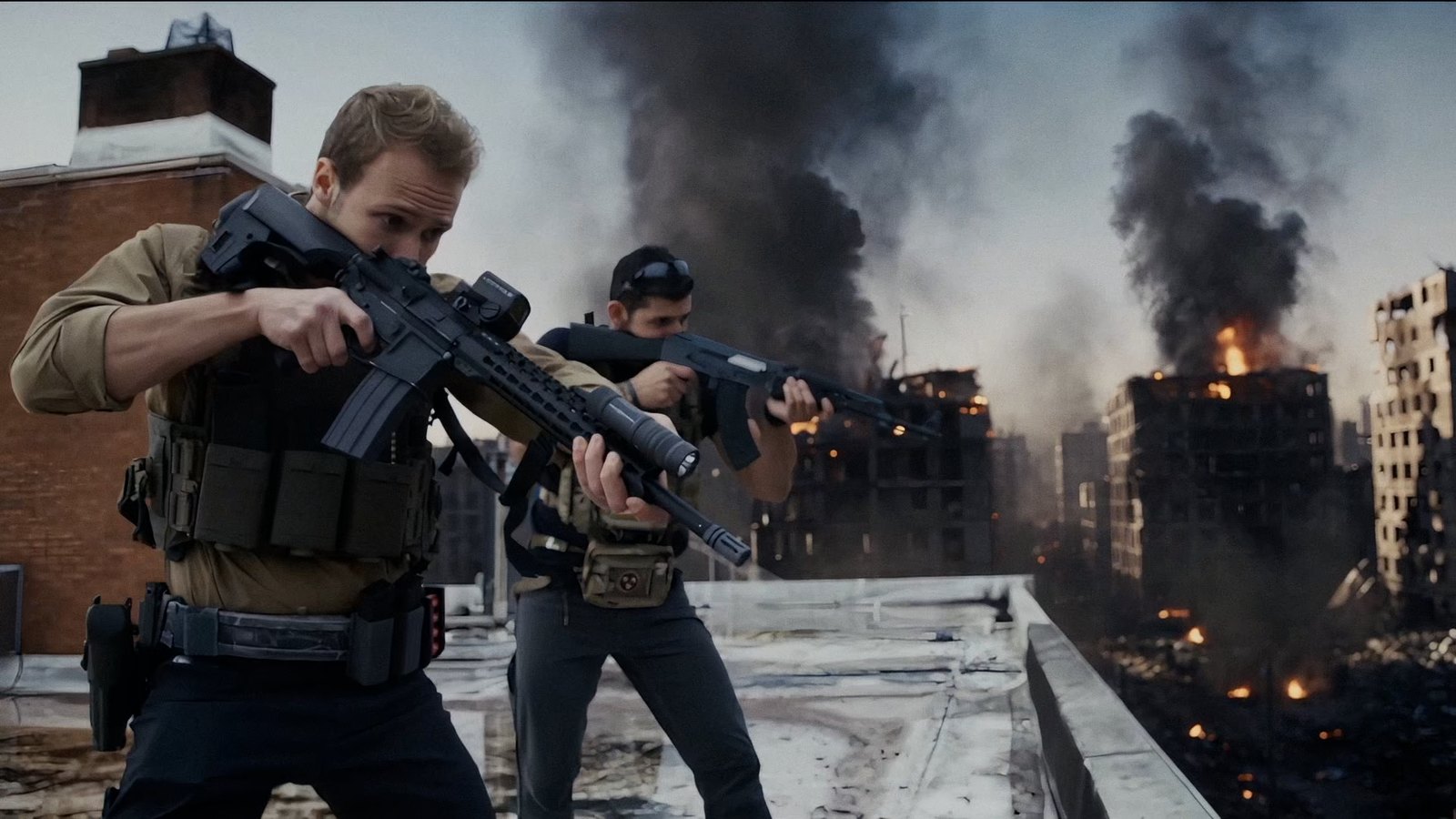
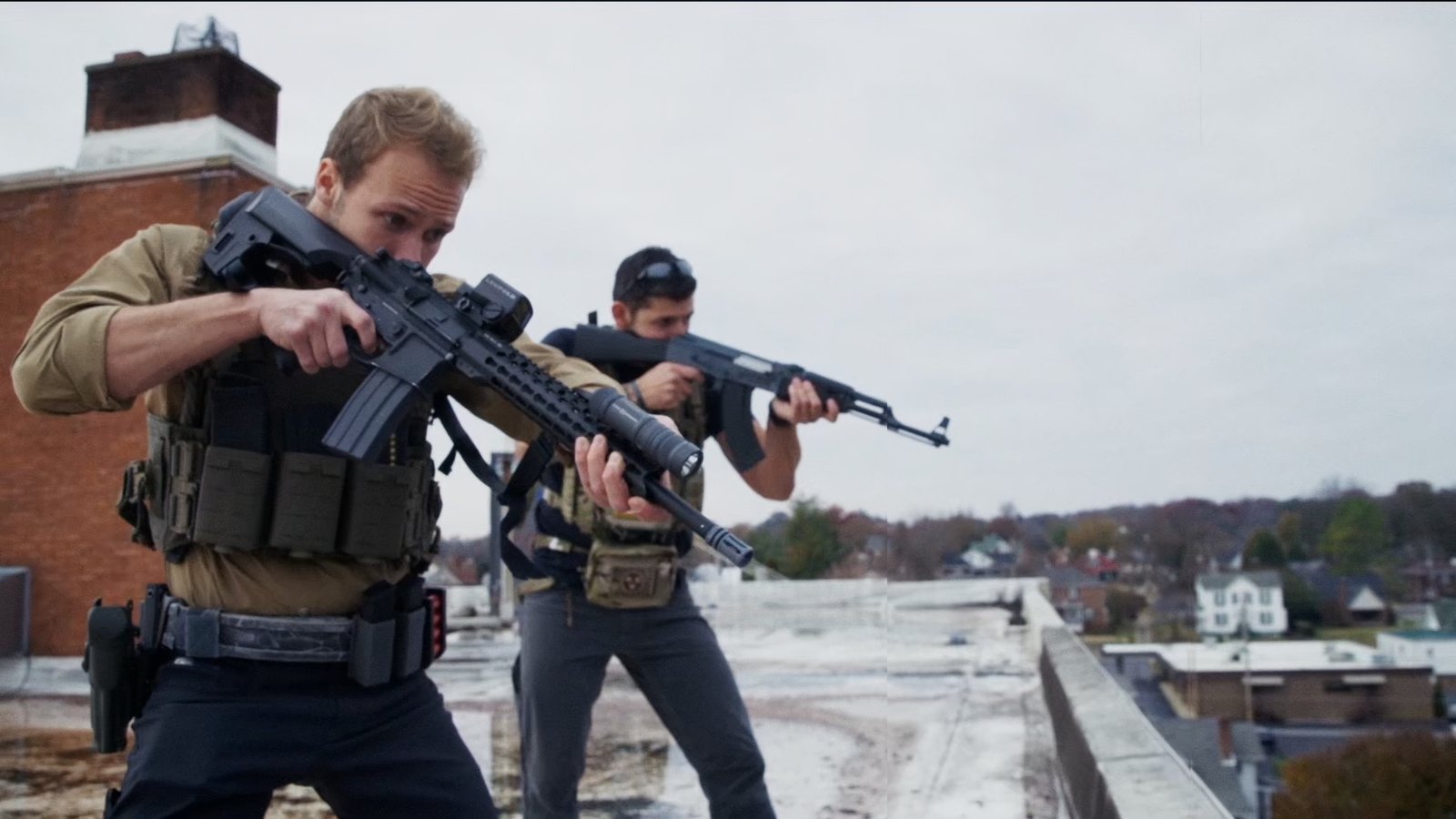
The same approach is not reserved for Amazon-sized budgets. We use it in our own work, and the shot below is from our showreel: one runner crosses a desert, a snowfield and a meadow without breaking stride, then two men on a rooftop hold their positions while the city behind them is replaced. The actors, the camera and the light stay exactly as they were shot. Only the world behind them changes.
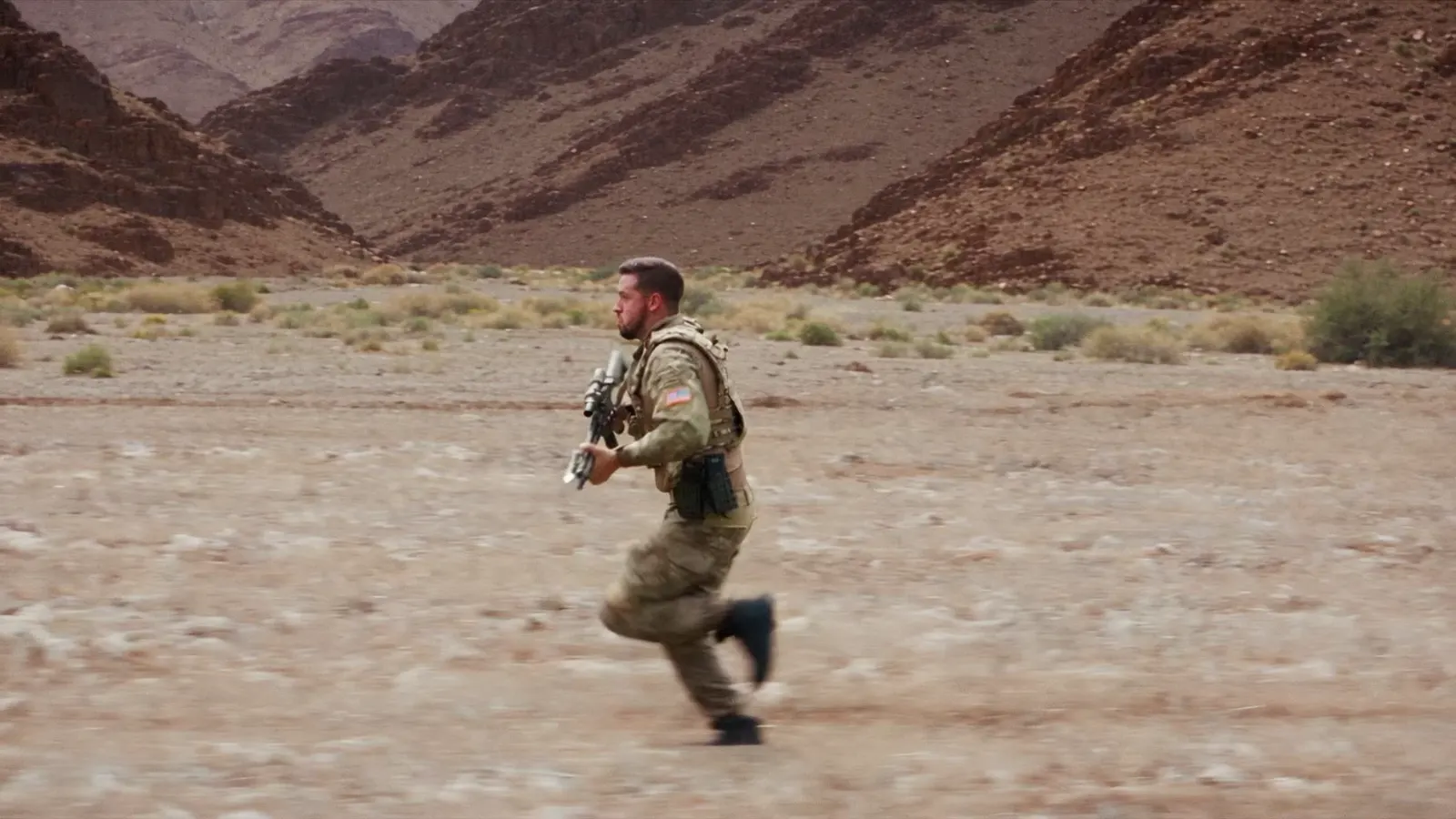
The Difference Machine showreel, 2026. Scroll to play the shot frame by frame.
How House of David built its world
The structure came first
The detail that matters for producers is the order of work. According to the production’s account, the team did not ask a model to invent a valley from a sentence. They built the structural foundation of each environment in Unreal Engine, the real-time engine widely used on LED volumes, which took about a week. Then they applied AI style transfer on top to push the result to photoreal and to match it to the show’s own photography.
That sequence solves the problem most AI demos quietly skip. A model asked for “a desert valley at dusk” forty times gives you forty valleys. A model asked to repaint the same geometry forty times gives you one valley in forty angles. The geometry holds the world together. The model supplies the surface.
The actors stayed real
Erwin describes the method as putting “a very real camera on a very real actor,” with the digital world as “the puppet”. The performance, the costume and the eyeline were captured on set. What changed was everything behind the actor.
One of us saw this from the inside. Milad Mesof, our VFX and compositing lead, worked on the second season of House of David as a generative AI artist. The shot below is from his showreel: a group of actors walking across a bare green stage, and the same take with the village, the walls and the terraced hills in place behind them.
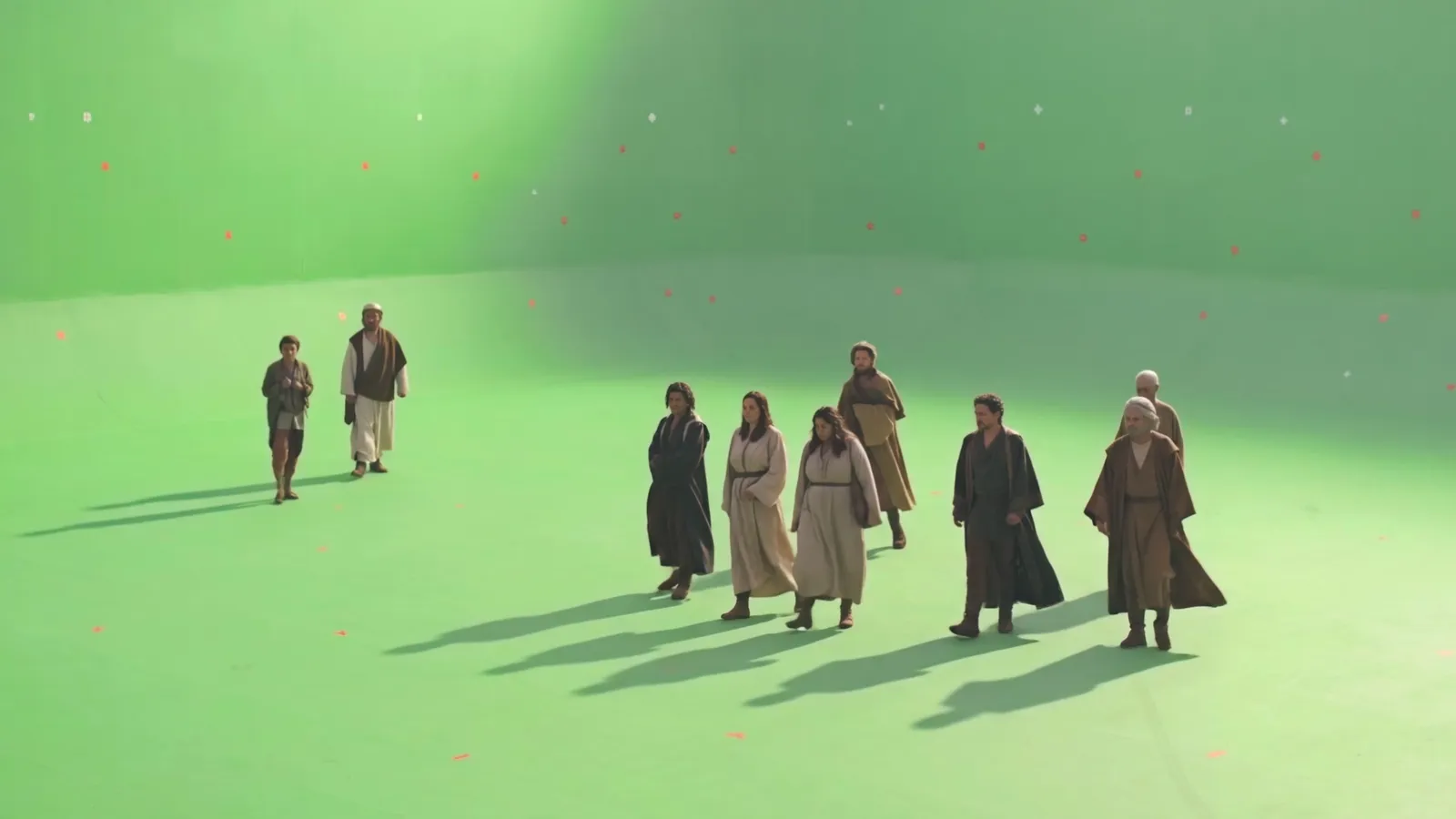
Frames from Milad Mesof's showreel: House of David, Season 2 (Amazon MGM Studios, 2025). Green-screen plate and finished environment in one take.
Most of what was generated never made it to screen
Erwin also said that for every VFX shot in the show, the team generated about twenty times that amount. That ratio is worth holding on to. The generation is cheap. The selection, the matching and the rejection are where the work sits, and they need someone who knows what the shot has to be.
Amazon’s global head of VFX, Chris del Conte, described the shift between seasons as moving from improvising with the tools to planning them into the workflow: “Season two, you actually planned for Gen AI to be the workflow”.
How this was done before
Travel to the location, or build it
For a period or genre production, the environment used to be a line item with two expensive answers. You took the crew to a place that looked right, or you built one. Both carry costs a Herstellungsleiter knows by heart. Sunny Vohra, owner of Twickenham Film Studios, describes reshooting a single scene on location as having “spent half a million”.
We looked at the German version of this problem in The Carbon Line Nobody Put in the Budget: 1899 moved an ocean voyage into the DARK BAY volume at Babelsberg because taking a 200-person crew across Europe was not a risk the producers could take.
The virtual environment, built by hand
LED volumes removed the trip, but they did not remove the build. A virtual environment in Unreal Engine is still modelled, textured and lit by artists. The figures cited alongside the House of David panel put a typical environment at 10 to 12 weeks and between $15,000 and $200,000. For a series with a dozen distinct locations, those figures add up quickly.
The rational choice for a mid-budget drama was to write around the expensive place, and the producers who did so were reading their budgets correctly.
If you are weighing which of your own locations could come off the schedule, that is the conversation we have with producers, and half an hour is usually enough to see where a project stands.
Thirty minutes is usually enough to understand whether it makes sense for your project and what it would realistically take to implement.
Book a conversation →What this means for producers
One shot is easy. An episode is the job.
A single replaced background is a solved problem on the right shot. The harder question, and the one that decides whether this is a production method or a demo, is whether the same street holds across every shot of a scene: the same façades, the same light direction, the same rubble in the same place when the camera comes back to it.
Roland Berger’s analysis of AI in VFX names this as the central blocker. Production needs results that “hold across shots, repeatable results and art direction rather than repeated re-rolling”. The House of David order of work is one answer to it: anchor the world in fixed geometry first, and let the model work on the surface.
Camera movement is still the line
On a locked-off or slow camera, a replaced background composites cleanly today. The moment the camera moves with intent, through a crowd, past reflective surfaces, around the actor, the problem gets harder: parallax, edges and motion blur all have to agree between a real foreground and a generated world. Vendors’ own guidance still recommends “still or smooth camera movements” for background work. Newer video models are improving on moving shots, but this is where marketing overpromises most, and there is no public benchmark that tells you how far they have come.
The practical consequence is a design decision made before the shoot: which shots carry the camera move, and which ones hold still so the world behind them can be replaced.
A green screen helps, but it is no longer the entry ticket
Research methods can now replace a background without a green screen, using segmentation to separate the actor and diffusion models to build the new environment. Practitioners still report a cleaner result when the plate is shot for the composite. Whether to hang green is now a shot-by-shot call and no longer a rule for the whole production.
Before you commission an AI background
Ask which of your shots are candidates
Consider a hypothetical case: a post-war drama needs a destroyed city centre behind a two-hander on a street corner, and later a chase through the same streets. The dialogue scene, played on a locked-off wide with the environment behind the actors, is a strong candidate today. The chase, handheld through broken glass and water, is still a test today. The honest answer for most productions is a mix, and the mix is decided per shot.
Ask where the world lives
Ask any vendor one question: how does the same street stay the same street across forty shots? If the answer is a better prompt, expect drift. If the answer is a fixed 3D anchor, a locked set of references and a person who checks every shot against them, you are talking about a production method.
Check the rights before the look
Three German points belong in the same conversation. Purely machine-made output does not clear the Schöpfungshöhe under § 2 UrhG, so the human creative steering in your pipeline matters for who owns the result. The KI-Tarifvertrag only comes into play if the environment contains generated people. It was agreed to run until 30 June 2026, so check which version applies on your shooting dates. And the ARD and ZDF KI-Kodex is an editorial code for journalism and does not regulate visual effects in commissioned drama. We covered all three in detail in Using AI in Film and TV: Legal Aspects to Consider.
The background used to be something the budget decided before anyone opened the script. Now it can be decided shot by shot.
Thirty minutes is usually enough to understand whether it makes sense for your project and what it would realistically take to implement.
Book a conversation →Nobody built the valley
Back in House of David, a hundred thousand warriors stand on ground nobody built, lit to match actors who were really there. On our rooftop, two men hold the same pose while the city behind them burns. Both shots kept the one thing a camera has to capture on the day, the performance, and changed the part a production used to have to buy, build or travel to. House of David still needed a production team, a schedule and people to throw away most of what the models generated.
For a German period or genre drama, the useful questions now are which shots can carry an AI environment, how the world stays consistent across an episode, and who checks it frame by frame before it ships.