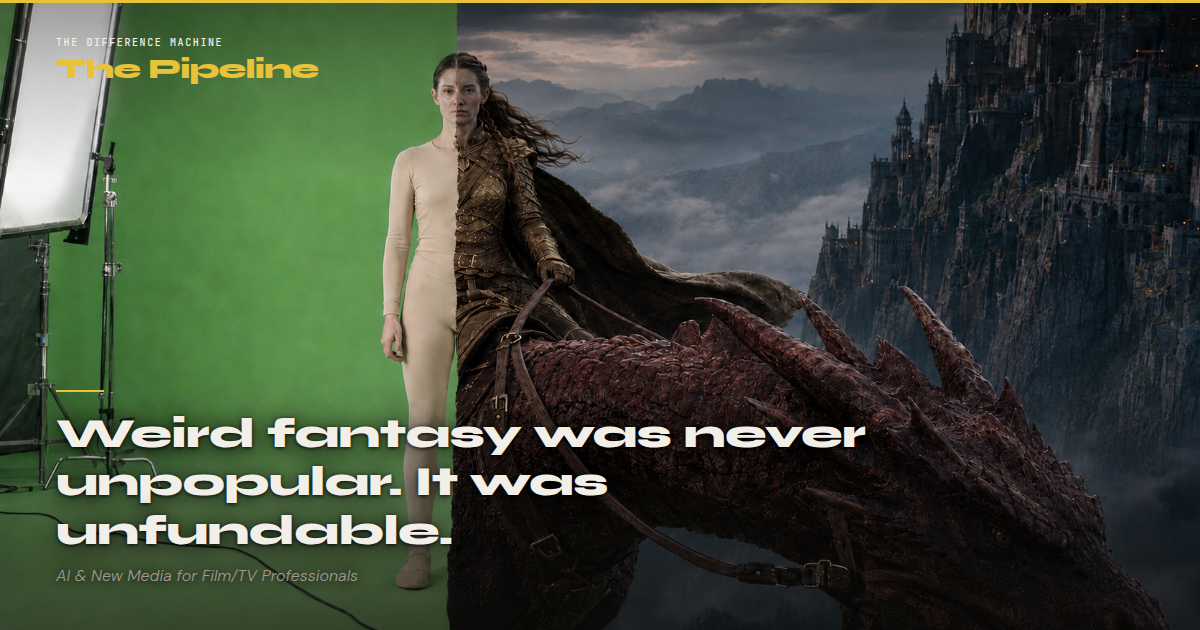
For twenty years the standard line in development meetings across Europe was some version of the same sentence: there is no audience for weird genre. Fantasy, science fiction, horror, alternate history, strange worlds. Too niche, too expensive, too risky. The project would die in financing, or a showrunner would learn not to pitch it in the first place. That sentence sounded like a verdict about taste. It was a verdict about arithmetic, and the arithmetic just changed.
The verdict was never about taste
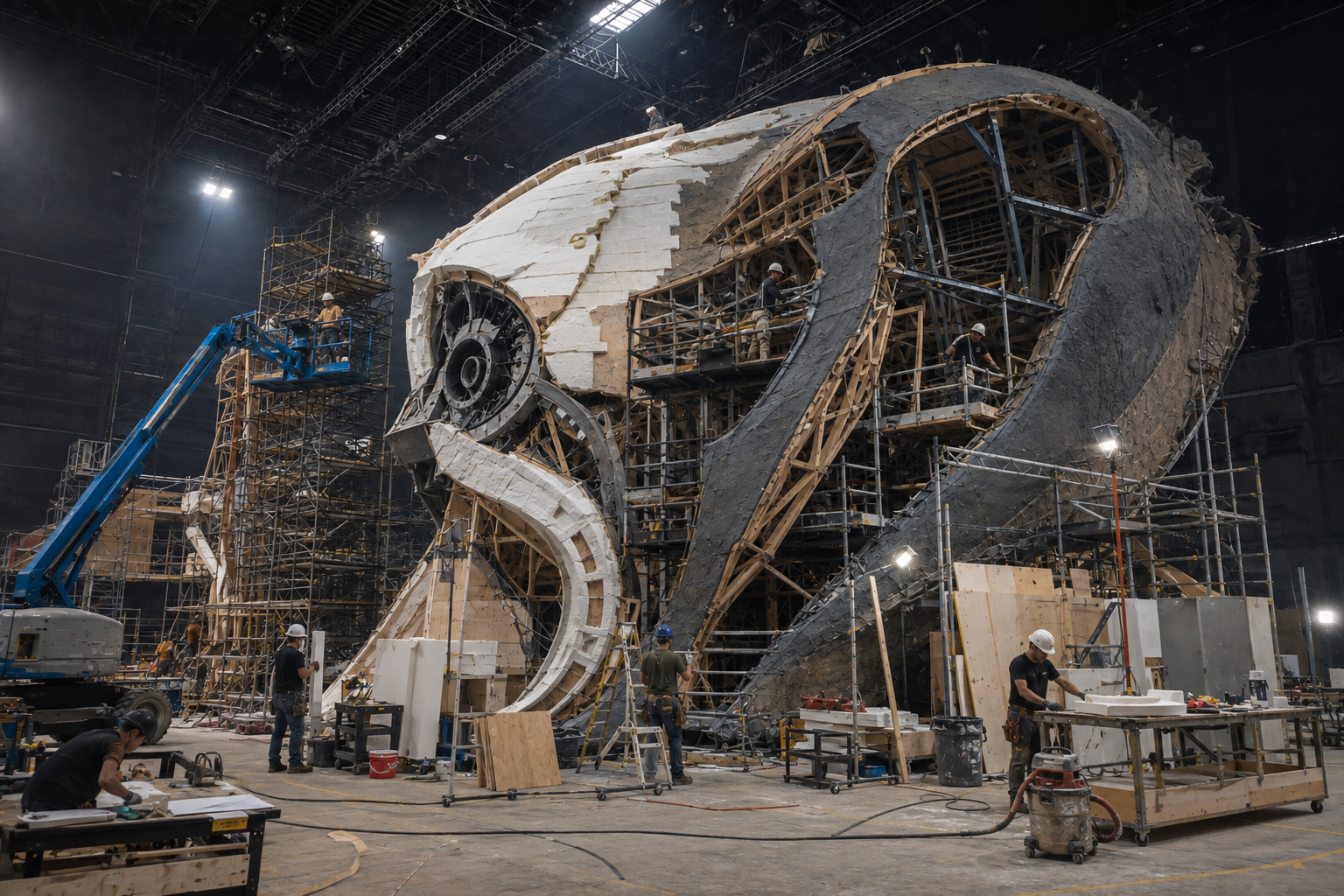
Speculative genre is the most expensive genre per screen minute in the business. A kitchen-sink drama needs a kitchen. A fantasy series needs a world, and the world has to be built, lit, rendered, and populated with things that do not exist. That single fact, not audience indifference, is why the old system worldwide would only greenlight speculative genre as pre-sold franchise IP or would not greenlight it at all.
The most expensive minutes on television
The numbers on the high end are almost hard to read as real. Amazon's The Rings of Power runs around 58 million dollars per episode on its first season and roughly the same on its second. HBO's House of the Dragon sits near 20 million. Netflix's Stranger Things reportedly reached 50 to 60 million per episode for its final season. Those are the sums it takes to put a convincing invented world on screen at franchise scale.
This is not a recent accident. In its January 2026 report on AI and film production, McKinsey traces the pattern back to CGI, which expanded precisely these effects-driven sci-fi and fantasy genres and helped push average Hollywood blockbuster budgets up 30 percent over two decades. The technology that made weird worlds possible is the same technology that made them expensive.
A commissioning system built on that cost structure has only two honest options for genre. Buy an audience in advance through a known property, a Tolkien estate or a Game of Thrones universe, or leave it alone. Streaming did not soften this. Streaming commissioning optimizes for the median viewer, and a niche-but-passionate genre audience is close to invisible to that math. The passion does not show up until the show exists, and the show does not get made because the passion cannot be counted in advance.
One strike
1899, the multilingual mystery from the creators of Dark, is the clean illustration. It cost roughly 62 million dollars for one season. It drew 257 million hours watched in five weeks across Netflix's global Top 10s. It was cancelled after that single season, with a reported completion rate under 50 percent, because the projected economics of future seasons did not close. A demonstrated global audience was not enough. The old cost structure gave weird genre exactly one strike.
The demand that supposedly did not exist
Here is the test the taste theory never had to pass. Wherever the gatekeeper's cost filter dropped away, speculative genre did not stay niche. It over-indexed immediately.
Web fiction, the gatekeeper-free control group
When anyone can publish and readers pay directly, the categories that traditional publishing barely acknowledged turn out to be enormous. China Literature, the largest web-novel company, posted about 1.05 billion dollars in revenue in 2025. Industry estimates put the global web-fiction market somewhere between 8 and 13 billion dollars depending on scope, and fantasy subgenres, the cultivation and isekai and progression stories that no acquisitions editor would have commissioned, sit among the most-consumed categories on the platforms. This is a billion-dollar genre market that formed entirely outside the commissioning system, and it now feeds screen adaptations back into it.
Microdrama, the audience nobody measured
The vertical-video drama boom is the format precedent for an audience that legacy television never counted. Global microdrama revenue reached about 11 billion dollars in 2025, on track for higher still, and platforms are already profitable at the unit level: DramaBox reported 323 million dollars in revenue and 10 million in net profit for 2024. Much of that catalog is melodrama, romance, and supernatural genre, served to viewers no broadcaster was measuring.
The gap on the incumbents themselves
Even inside the streamers, demand outruns supply for genre. In a 2023 Parrot Analytics analysis, fantasy made up 10.7 percent of Netflix's catalog but 16.5 percent of its demand. On Apple TV+, science fiction was 10.1 percent of the catalog and 22.5 percent of demand. The audience wants more of this than the platforms supply. And that audience is not who the cliché imagines: fantasy's largest age group is Gen Z, with a slight female skew, and science fiction splits close to evenly by gender across generations. Speculative genre is not a middle-aged-male niche. It is the young audience every legacy broadcaster keeps saying it wants to reach. This audience does not stop watching when nobody serves it. It migrates to whoever does.
The new economics
AI production inverts the genre cost hierarchy. Worldbuilding, creatures, environments, spectacle, the parts that made speculative genre unaffordable, stop being the expensive part. On the current tooling a generated world costs no more than a generated kitchen. The genre that the old system suppressed hardest is the one that blooms first on AI-native platforms, and that mirror image is the whole point.
The demand signal: Higgsfield Original Series
Higgsfield launched what it calls the first AI-native streaming platform, opening with a fully AI-generated pilot, Arena Zero. The commissioning mechanism is the part worth watching. Alongside a creator contest, Higgsfield has begun running a crowdsourced greenlight: viewers watch pilots and vote on which get developed into full series, instead of an editorial commissioning median deciding alone. The company reports its Action Contest drew 8,752 submissions from 139 countries and paid out 500,000 dollars to independent filmmakers.
Higgsfield is not the only platform that arrived at this mechanism. McKinsey's report names DreamFlare, a hybrid creation and distribution platform where creators publish episodic AI-enhanced stories directly to an audience that votes on which concepts get developed into full shows. Two platforms, independently, replaced the commissioning median with a count of people who actually watched.
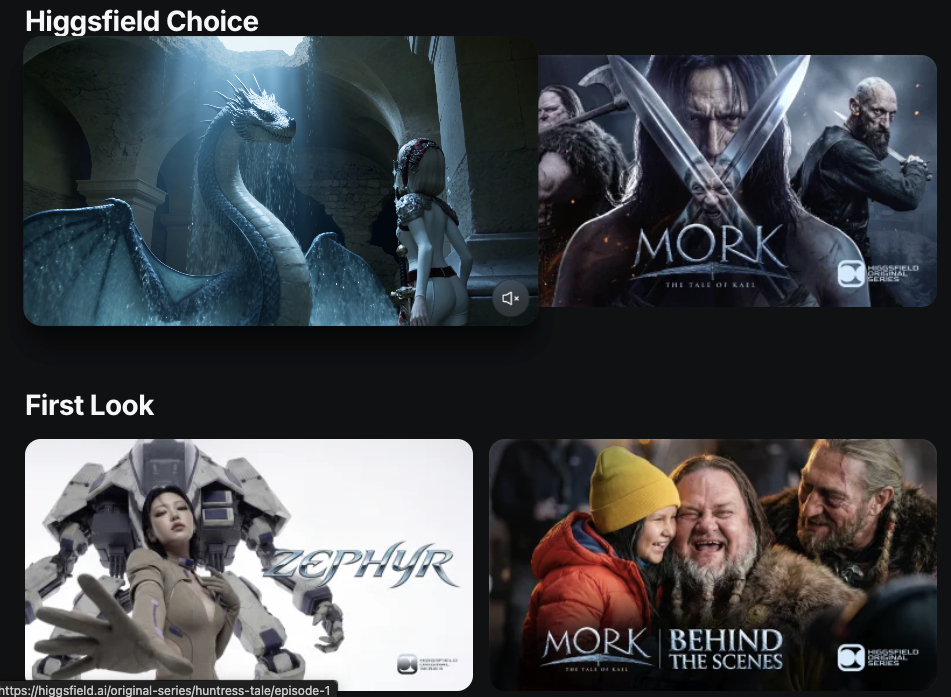
Now the content itself. Of the 21 series on the Original Series slate as of July 2026, clearly speculative titles outnumber clearly conventional ones six to one, twelve against two, with seven not classifiable from their listings alone (our own audit against the platform's episode pages). Given an open greenlight and near-zero world cost, the slate tilts hard toward exactly the genre the old economics kept off the air.
A caveat has to travel with every Higgsfield number, and it is the honest core of this section. The platform reports roughly 500 million dollars in annualized revenue by mid-2026, more than 15 million users, and around 4.5 million video generations a day. About 70 percent of that revenue is enterprise tool usage, not the streaming slate, and Original Series revenue is not broken out. So Higgsfield proves platform scale, capital conviction, and a working demand-signal mechanism. It does not yet prove a profit-and-loss statement for AI-native genre series. The precedents that are already net-positive are microdrama and web fiction.
The cost side
Two documented datapoints anchor the cost inversion. Critterz, an OpenAI-backed, AI-assisted animated feature made with human writers, artists, and voice actors, is in production on a budget under 30 million dollars and what The Ankler called a nine-month sprint, against the two to four years and hundreds of millions that traditional animation houses spend. And McKinsey, in that same January 2026 report, estimates that roughly 10 billion dollars of forecast US original-content spend in 2030 could be addressable by some form of AI, with around 60 billion in annual revenue redistributed within five years of the point where AI use overtakes the incumbent technology.
What this proves, and what it does not
AI removes the budget filter. It does not remove the storytelling filter. Current AI-native output is uneven, and the tooling is markedly weaker at long naturalistic dialogue and subtle human performance than at stylized worlds and spectacle. What the evidence establishes is demand and a cost inversion. It does not establish that craft is solved. Those are two different claims, and only the first one is proven.
McKinsey's interviews land in the same place. Executives told the firm that AI-generated output is not yet at a quality level to drive meaningful disruption, and that in many cases it does not meet premium production standards. That is the honest state of it, from a source with no reason to undersell the technology.
None of this is plug-and-play, and the first step is usually smaller than people expect. If you want to talk through what it would take for a specific project, the calendar is below.
Und in Deutschland?
The global story lands on a local question. If the audience for weird genre was always there and the economics now close, what does that mean for a German market that spent two decades not serving it?
The audience Germany is losing
The numbers are stark. In the last published breakdown, for the first half of 2022, the average ZDF viewer was 65 and the average Das Erste viewer 64. The ARD/ZDF-Medienstudie 2025 supplies the rest in a single table. On a given day, 25 percent of 14- to 29-year-olds watch linear television, for 22 minutes, against 92 percent of the over-70s for 248 minutes. Out of roughly 160 minutes of video a young German viewer consumes daily, linear television holds 22 of them. Among younger viewers the study finds saturation, a plateau in the non-linear habit, with no sign of a swing back. Over half of German teenagers watch Netflix several times a week. The young audience did not stop watching. It went where the genre is.
Why Germany could not serve them
Two structural reasons, both about cost, not appetite. Genre was systematically filtered out of German public funding. The director Andreas Marschall put the culture of it plainly: "If you apply for public funding for a horror film, people look at you as if you wanted to shoot a porno." (In the original German: "Wenn man Fördermittel für einen Horrorfilm beantragt, wird man angeschaut, als wollte man einen Porno drehen.") And the domestic cost ceiling sits far below franchise-genre economics. A Tatort episode runs roughly 1.7 to 1.9 million euros, about 21,500 euros per broadcast minute by ARD's own disclosure. Babylon Berlin, the German prestige benchmark, cost about 40 million euros across its first two seasons, roughly 2.5 million per episode. Franchise-genre economics of 20 to 58 million dollars an episode sit 10 to 30 times above that ceiling. "German fantasy series" was an oxymoron of arithmetic. And 1899, the one attempt at the top of the range, was made by proven German creators with a demonstrated global audience and cancelled anyway. The wound is real.
A window worth naming precisely
Something is shifting at the edge of this, and it deserves precision, not hype. Regulators are moving on youth access to social media. Australia's under-16 ban has been enforced since December 2025, and platforms removed 4.7 million accounts belonging to Australian children in the weeks after it took effect. Compliance is leaky: around 70 percent of under-16s reportedly kept access through workarounds. The European Parliament passed a non-binding resolution in November 2025, by 483 votes to 92, calling for an EU-wide digital minimum age of 16. A von der Leyen expert panel reports by summer 2026, and Denmark and France are pursuing national variants.
The honest reading: this does not mean teenagers flood back to linear television. Displaced attention goes to gaming, messaging, and YouTube first. What it does mean is that, for the first time in about fifteen years, teen attention is structurally in play. If even part of it comes loose, the question turns sharp: what will a traditional channel offer a returning 15-year-old? Today's answer is programming built for a 65-year-old median viewer. Content pipelines take 12 to 24 months to fill. Whoever wants something to offer when the regulation bites has to start developing now.
The hybrid advantage
Here is the constructive turn, and it is a complementarity argument, not a replacement one. AI is weakest exactly where German traditional production is strongest: naturalistic performance, actors, dramaturgy, craft. It is strongest exactly where German budgets never reached: worlds, creatures, spectacle. Combining the two is not a compromise. Each side covers the other's structural weakness. Germany already holds the craft base, the studios, the department heads, the acting talent, the writing tradition, to run a hybrid model better than a pure-AI platform can, provided it moves before the audience finishes leaving.
Consider a hypothetical case: a German showrunner with an alternate-history series shelved three years ago, killed in financing on the grounds that its world was too expensive to build for an unproven audience. The same showrunner today can commission AI development materials, a visual bible and a short sizzle, that show the world convincingly for a fraction of what a broadcaster pitch used to cost, and reopen the financing conversation with the thing that was always missing from it: proof that the world is real and the audience is there.
Audiences never stopped wanting weird worlds. The industry simply could not afford to build them. That is the part that changed.
This is the production model we run at The Difference Machine: AI worlds and spectacle combined with traditional narrative craft and on-set performance, across every stage from development to post. The concrete entry point is exactly that development artifact, a visual bible or sizzle reel that proves the world before the financing conversation. Whoever wants their genre project back, or their young audience back, that is the conversation to have.
The cost verdict has moved
For twenty years the industry told itself there was no audience for weird genre. The truth was quieter and more expensive: there was an audience, and there was no budget line that could serve it. Both halves of that sentence have now come apart. The audience is measurable, in web fiction revenue, microdrama profit, streaming demand curves, and a six-to-one genre tilt on the first platform where world cost fell to zero. And the budget line is no longer the wall it was. The audience is already somewhere else, watching. The only open question is who builds the worlds it came for.