Which small VFX fixes on a drama should go to AI? The ones that repeat many times and look alike each time: the same object, in similar light, with no face involved. A one-off fix, or anything on a face, still goes to an artist.
There are a lot of these fixes. The second season of Severance carries roughly 3,500 visual effects shots over ten episodes, and its production VFX supervisor, Eric Leven of ILM, says every one of them is invisible. "It's a really different calculus," he told ILM, "because nobody talks about them." Below is how to decide which of them to give to a model, and where 47 common types land.
When AI pays off: many shots that look alike
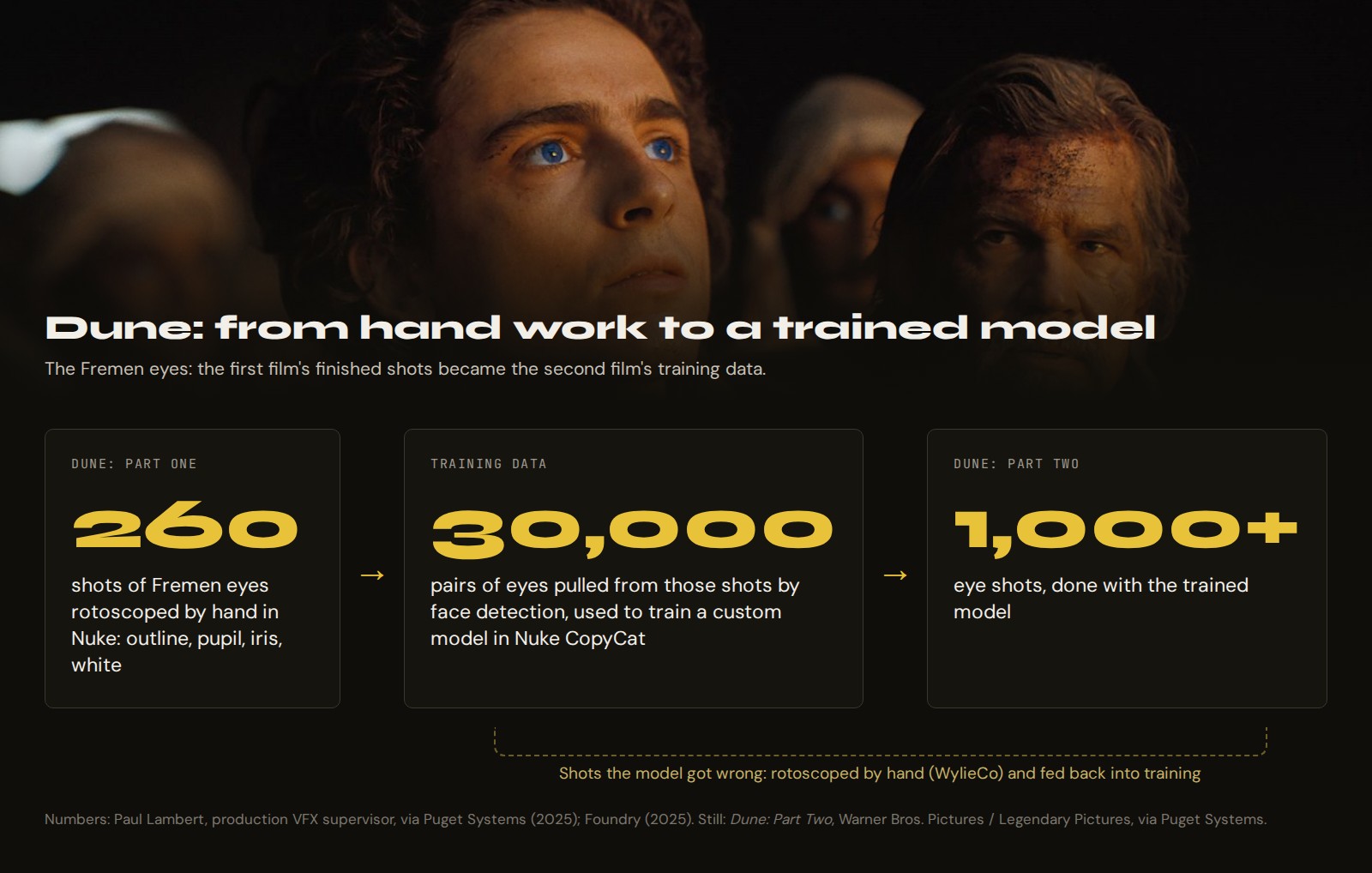
In Dune, the Fremen have bright blue eyes, and every one of them is painted in after the shoot. On the first film (2021), production VFX supervisor Paul Lambert's team did it by hand: "I had 260 shots manually rotoscoped in Nuke." Dune: Part Two (2024) had more than 1,000 such shots. The team took the 260 finished shots, which gave 30,000 pairs of eyes, and trained a custom model on them in Nuke's CopyCat. Shots the model got wrong were done by hand and fed back into training. Foundry says the work took a fraction of the time.
What repeated was one task: the same blue on the same kind of surface, an eye, in a thousand shots. Because the fix looked alike every time, the frames artists had already finished could teach a model to do the next ones.
Where it stops: many shots, none alike
Fallout shows the other side. The Ghoul has no nose, and the nose had to be removed in more than 500 shots. FutureWorks did the work in 2023 for the first season, which premiered in 2024. With the tools of that time, the team tested a machine-learning approach and dropped it: it "wouldn't really give us the flexibility we would need for 500-plus shots in so many varieties of body positions, environments, and lighting conditions," said production VFX supervisor Jay Worth. The shots were done in 3D.
The fix repeated, but no two shots looked alike. Every shot had a different head angle, a different light and a different background. The tools have improved since, but faces are still where we keep the artist in charge: blood on faces, beauty and skin work, and any fix on a face with a moving camera. A model can help there, trained on the artist's own frames for that sequence, but the artist leads and finishes.
Three questions before you give a fix to AI
1. How many shots of this type are there?
If a type shows up once, an artist will paint it faster than anyone can set up and check a model. If it shows up forty times across the season, the model is set up once and used on all forty.
2. How alike are they?
Same kind of surface, similar light and angle, no face: the model can do the fix and an artist reviews it. Add a moving camera, reflections or light that changes, and the model only follows the movement or paints a first fill; the artist finishes the shot. Faces and bodies in motion go to the artist.
3. How much admin does each shot carry?
On a typical studio status sheet, every shot is its own line: status, vendor, turnover date, version, delivery date, cost. Behind each line there is a bid, a handover to the vendor, a review, notes and a re-delivery. That admin doesn't get much smaller when the shot does, which is why a long list of small fixes costs more than the work on screen suggests.
In our own estimates, a small fix like a logo or a number plate takes an artist between a quarter of a day and half a day. Every shot also carries production, coordination and review time on top, and on simple shots that adds up to nearly as much as the artist's own time.
Take forty number plates spread over eight episodes. That's ten to twenty days of artist work. Handled one by one, it's also forty lines, forty handovers and forty review rounds, each with its own coordination. Sorted as one type, it's one job, with one setup and one agreed look, checked against the same spec. Each shot still gets checked, but the coordination around them happens once for the batch instead of forty times.
The 47, sorted
Here are the three questions applied to 47 types of small fix that turn up on most drama shot lists, in seven groups. Each group is split in two.
AI pass: the model does the fix and an artist reviews it.
AI-assisted: the model does part of the job, usually tracking, the matte or a first fill, and an artist finishes the shot.
What stays with the artist is listed after the groups.

Clearance: brands, names and rights
Things that were in front of the camera and can't be on the screen.
AI pass · a model does the fix, an artist reviews it
- 1Number plates. Real plates replaced with cleared ones.
- 2Logos on clothing. A brand on a jacket or a shirt. Framestore removed one from an actor's football shirt with a model trained on four painted frames.
- 3Logos on products. Cups, bottles, packaging on a table.
- 4Brand names on shopfronts. A real chain store behind the scene.
- 5Posters and billboards. Uncleared ads on walls and bus shelters.
- 6Artwork on walls. Paintings and graffiti nobody cleared.
- 7Real addresses. House numbers, street names, phone numbers on vans.
AI-assisted · a model tracks or fills, an artist finishes
- 8Bystanders without a release. Passers-by in the background, blurred or replaced.
Period: removing the present
For any story set before about 1995, the modern street has to go.
AI pass · a model does the fix, an artist reviews it
- 9Satellite dishes.
- 10Air-conditioning units and CCTV cameras on facades.
- 11Antennas and solar panels on roofs.
- 12Modern street lights.
- 13Road markings and modern traffic signs.
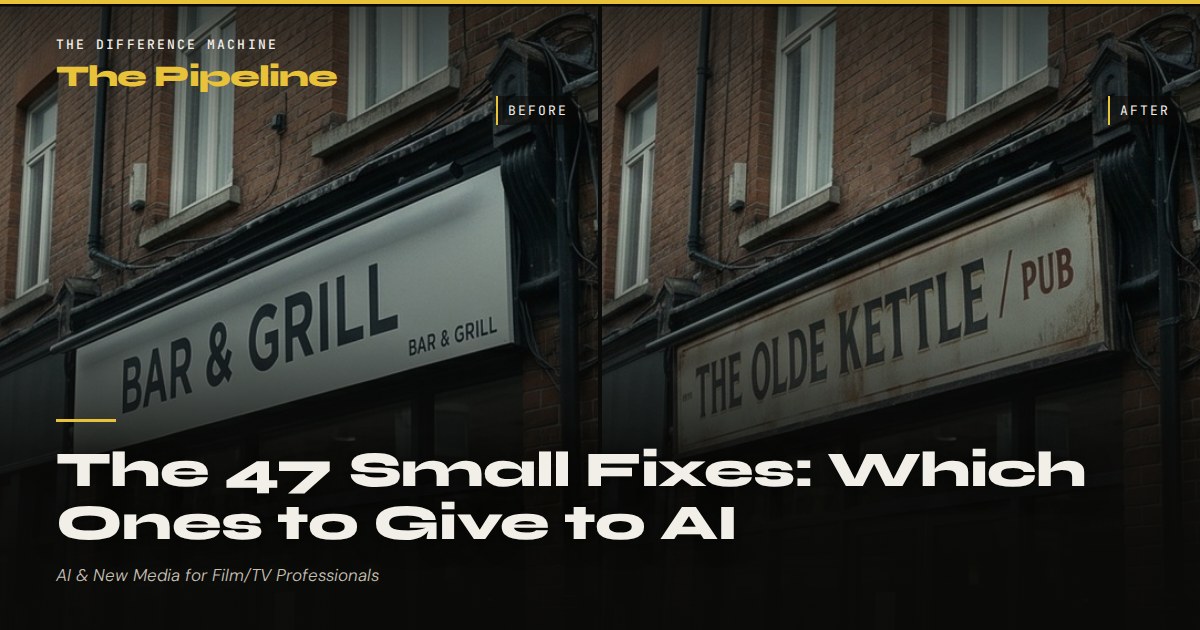
- 14Shop signs changed to the period. The pair on the cover is one of them.
- 15Contrails and aircraft in the sky.
AI-assisted · a model tracks or fills, an artist finishes
- 16Modern cars parked in the background.
- 17Plastic windows and modern doors. Geometry and reflections make these harder.
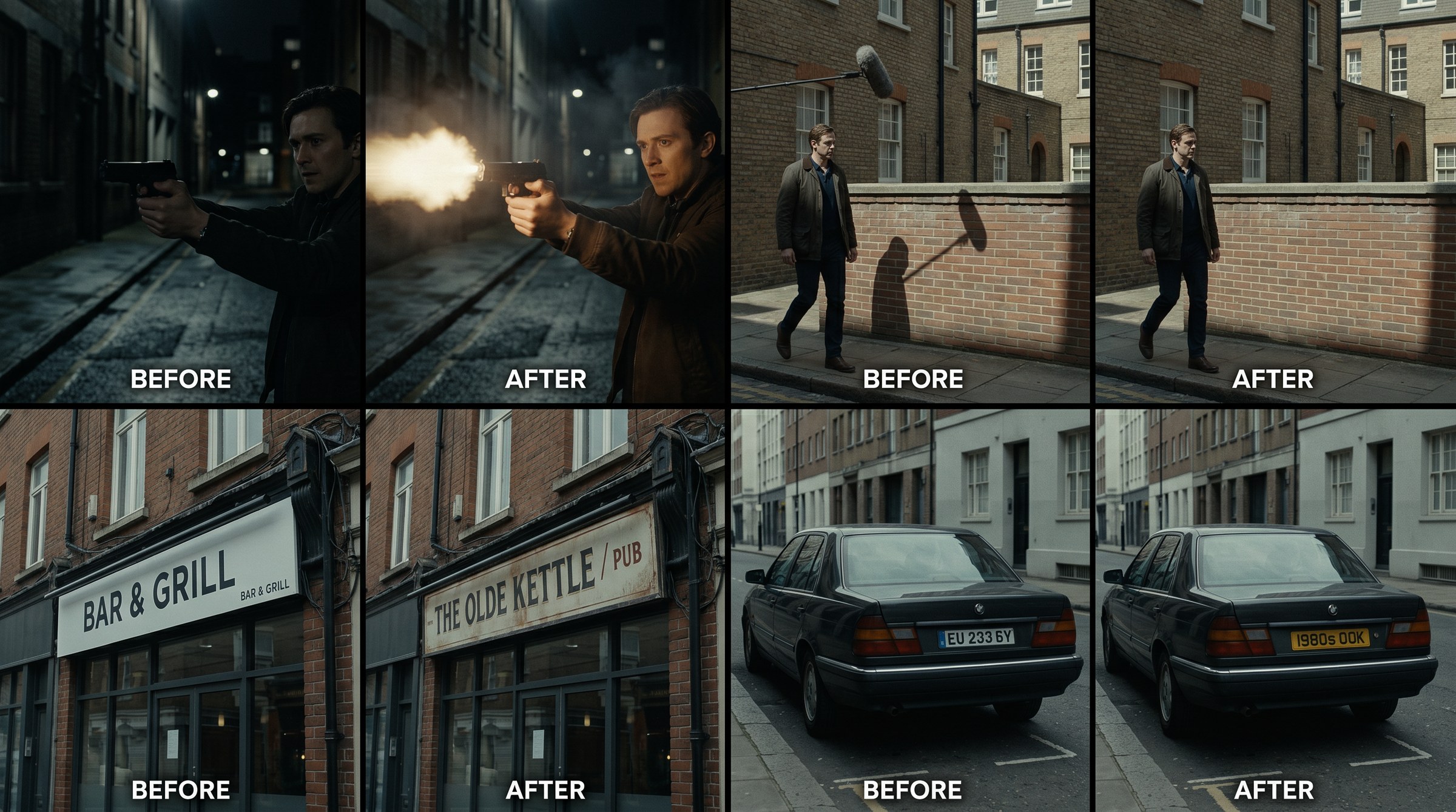
The crew in the frame
Equipment that should never have been seen.
AI pass · a model does the fix, an artist reviews it
- 18Boom microphone dipping into the top of the frame.
- 19Boom shadow on a wall. On a face, it goes to the artist.
- 20Light stands and flags at the edge of the frame.
- 21Dolly track and camera marks on the ground.
- 22Tape marks on the floor.
- 23Tracking markers on green screens and set pieces.
- 24Wires and rigs against sky or plain walls.
AI-assisted · a model tracks or fills, an artist finishes
- 25Crew and camera reflected in windows, mirrors and car paint.
30 minutes. We sort your list: what goes to a model, what stays with the artist. Free, no commitment.
Weapons and action
Effects you can't do safely or cheaply on set.
AI pass · a model does the fix, an artist reviews it
- 26Muzzle flashes. Prop guns don't fire, so the flash goes in later.
- 27Shell casings ejected from the gun.
- 28Bullet hits on walls and furniture, without squibs.
- 29Sparks and ricochets.
- 30Dust and debris from impacts.
AI-assisted · a model tracks or fills, an artist finishes
- 31Breaking glass.
- 32Blood hits on clothing. Blood on faces stays with the artist.
Weather and atmosphere
The weather that didn't turn up on the day.
AI pass · a model does the fix, an artist reviews it
- 33Sky replacement on locked or slow shots.
- 34Fog and haze layers.
AI-assisted · a model tracks or fills, an artist finishes
- 35Sky replacement on a moving camera.
- 36Rain added or made heavier.
- 37Snow on the ground and in the air. Severance added it to nearly every exterior.
- 38Breath vapour in cold scenes shot in warm weather.
- 39Wet streets for a scene shot dry.
Screens and inserts
Everything with text or an image on it.
AI pass · a model does the fix, an artist reviews it
- 40Newspapers, letters and documents with fictional text.
AI-assisted · a model tracks or fills, an artist finishes
- 41Phone screens. The model tracks the screen; the artist sets the insert and its reflections.
- 42Laptop and monitor screens.
- 43Televisions in the background.
- 44Glare and reflections on screens.
Continuity and clean-up
The fixes that come out of the edit.
AI pass · a model does the fix, an artist reviews it
- 45Flicker, sensor dust and dead pixels.
AI-assisted · a model tracks or fills, an artist finishes
- 46Prop continuity. The level in a glass, the length of a cigarette.
- 47Tattoos on arms and bodies covered for a role.
What stays with the artist
Not in the 47, because no two of these shots look alike:
- Blood hits and wounds on faces.
- Beauty and skin work.
- Changed anatomy, like the Ghoul's nose.
- Any fix on a face with a moving camera.
Using the list on your next production
Count your list by type
Post lists are sorted by episode, because that's how editorial turns them over. Sort yours by the 47 types. If one type shows up fifty times, treat it as one job.
Mark each type
Put the mark next to each type: AI pass, AI-assisted, or artist. Any vendor should be able to tell you which of your shots they wouldn't give to a model.
Keep one review standard
A shot done with a model goes through the same review as every other shot, by the same supervisor, against the same delivery spec.
At The Difference Machine, small-shot work is one of the services we run, with an artist finishing every shot. If you want a second opinion on which of your 47 go to a model and which don't, that is the conversation we have before anything is generated.
30 minutes. We sort your list: what goes to a model, what stays with the artist. Free, no commitment.
The fixes will still be invisible
The Severance team won't be talking about its 3,500 shots, and nobody will talk about yours. The list won't get shorter either. What changes is the cost of each line on it: where the same fix repeats a hundred times, it no longer has to be done a hundred times by hand.
AI and new media for film and TV professionals. One piece every two weeks. No noise.