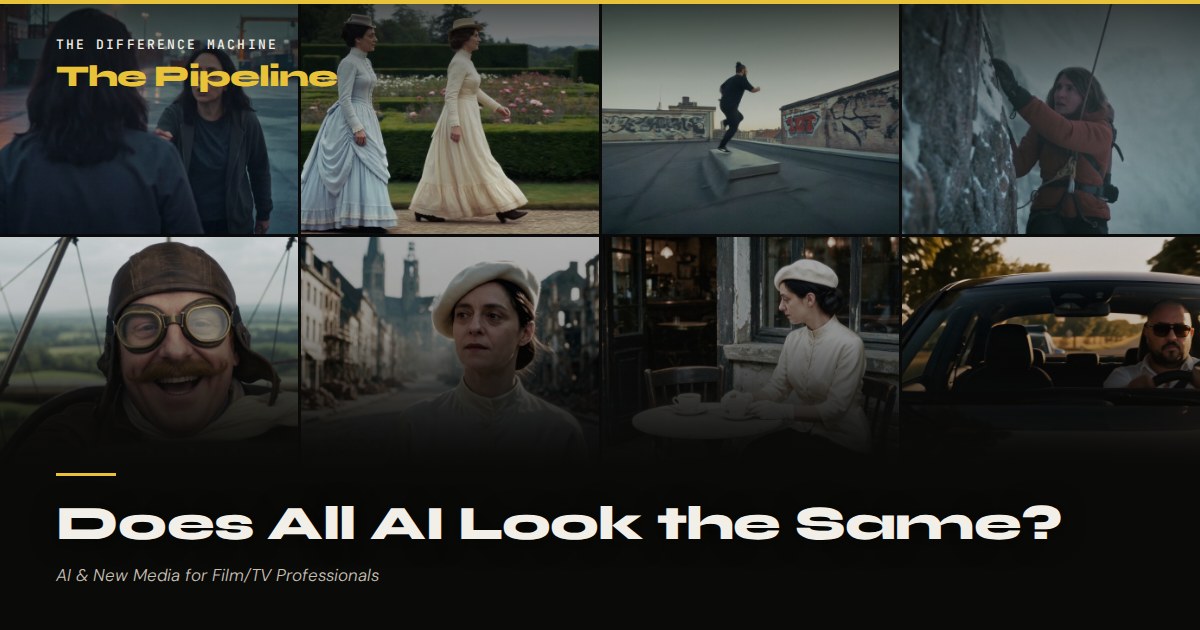
Will it look like every other AI clip? Producers ask us this before an AI shot is commissioned.
Yes and no. It depends on you. Our position at The Difference Machine is that AI is a tool that helps people carry out their own creative decisions. How a generated shot looks depends on the decision you make, and on whether you have enough information to make it. This article is about the second part.
The risk is real, and big names do not protect against it. In January, Darren Aronofsky’s AI studio Primordial Soup and Google DeepMind released On This Day… 1776, and reviewers took it apart for its AI look: flat faces, characters filmed from behind, the word “AMERICA” melting into “AAMEREEDD”. Steven S. DeKnight, showrunner of Daredevil: Born Again, called it “a complete betrayal of cinema”.
The reasons all AI footage may look alike
Every model has a house style
Three recent studies measure what viewers notice by eye.
Researchers who sampled 720,000 images from twelve text-to-image models found that all of them show limited variation, and that the stronger models were less varied than the weaker ones. Their example is easy to remember: ask for a cookie and 98% of them come out round.
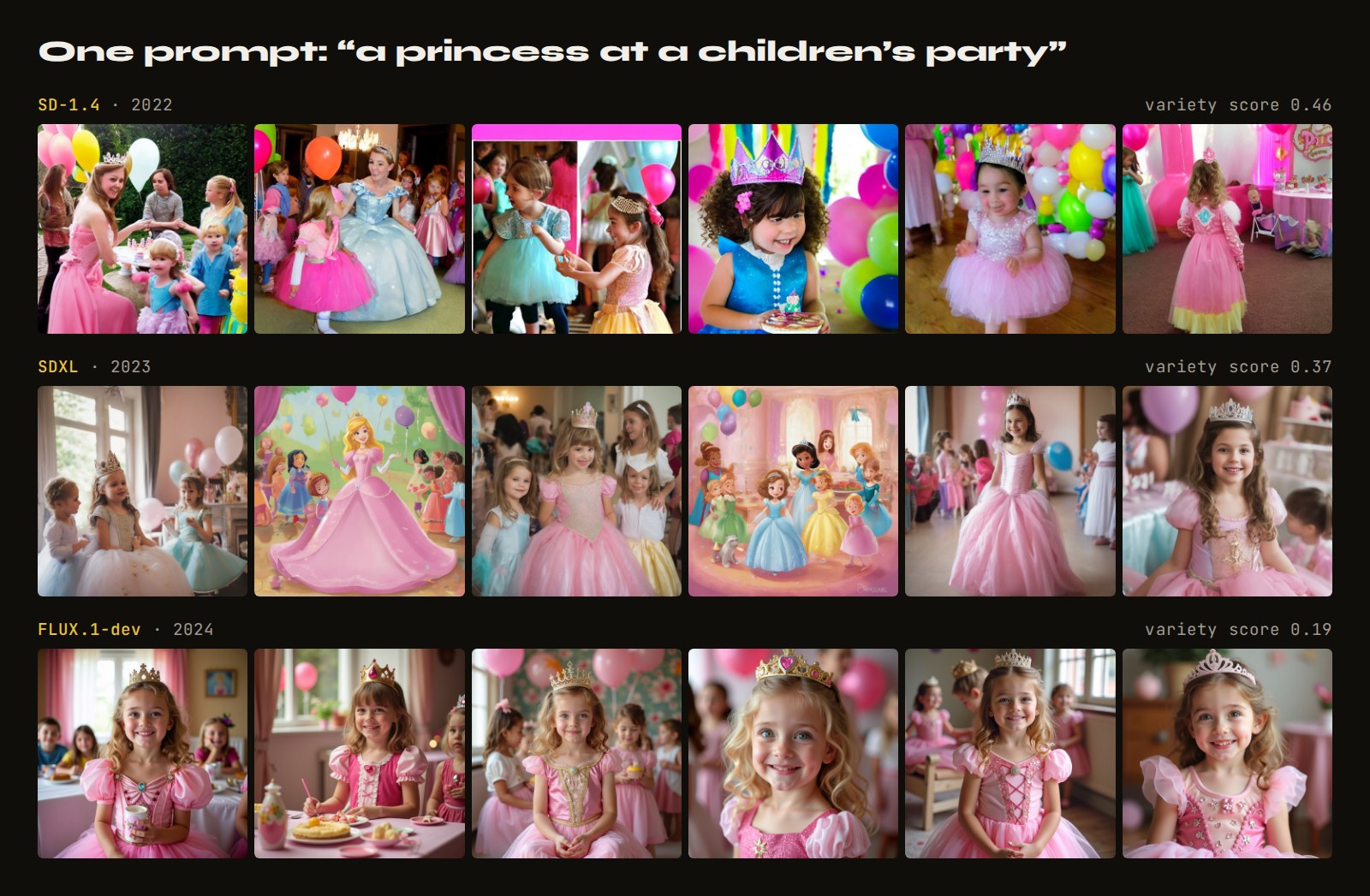
A 2026 study from Stanford, UC San Diego and MIT profiled 26 image generators released over four years. Each model has a stable, recognisable default look, distinct enough that a classifier can tell which model made a single image at about nine times chance. The defaults lean toward glossy lifestyle and editorial photography, and the distance between model families shrank by about a quarter over the four years. The models are converging on one look.
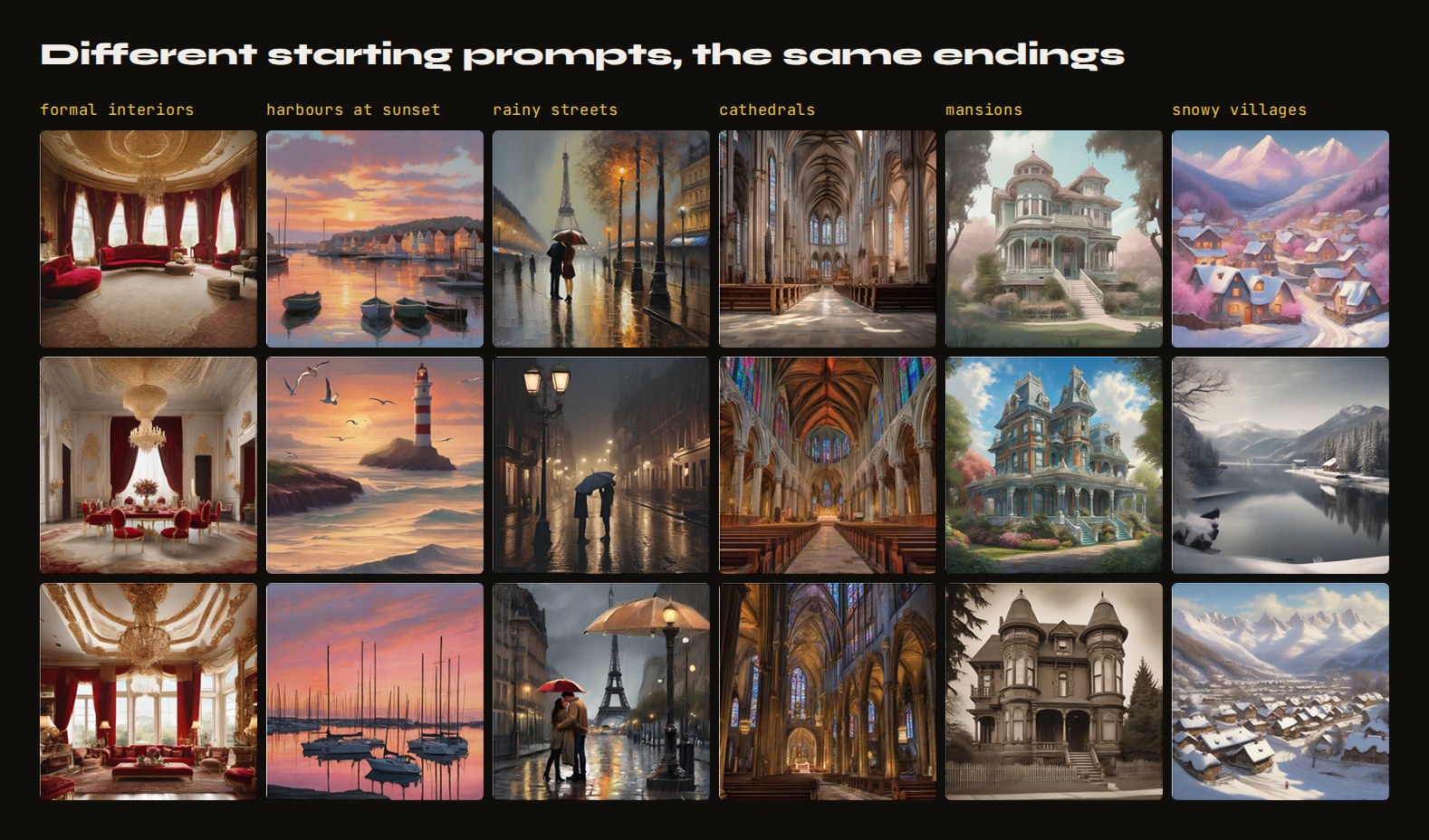
The third study, published in Patterns, let one model generate an image and another describe it, then fed the description back in, for 700 chains of a hundred rounds each. The chains ended in one of twelve generic motifs: stormy lighthouses, formal interiors, rainy city streets, rustic buildings. The authors called it “visual elevator music”.
Audiences have learned to read it
Coca-Cola’s AI-made holiday commercial in 2024 drew criticism for uncanny faces and truck wheels that glided instead of turning. The 2025 version replaced the people with animals and was criticised again. 1776 shows the same reaction for long-form drama. The audience no longer needs to be told a shot is generated. It recognises the look.
The default can be countered
None of this is fixed. A model falls back on its house style when it has nothing better to work from, and productions that gave it something better got their own look back. The rest of this article is about how they did it: by deciding the look before generating, by giving the model the production’s own material, by starting from a real performer and a real set, and by finishing the shots the way film is finished.
The method is older than AI
Tests first, then the shoot
For a camera team, deciding the look first is not new. A show’s look has never come from the camera’s default settings. It is decided in tests before the first shooting day: stock or sensor, lenses, filtration, the grade. Colourists now work with directors and cinematographers in pre-production to build the look that goes onto the monitors on set. Roger Deakins describes his own approach in one line: “Just shoot some tests and take them to the DI suite.”
Early AI work skipped that step. A prompt went in, a shot came out, and the look was whatever the model preferred that day. The productions below did what film crews have always done: they decided the look first and made the generated material serve it.
If you are weighing an AI shot for your own production, the first conversation is about the look you already have, and we are happy to have it with you.
30 minutes. We’ll figure out if it makes sense for your project. Free, no commitment.
How productions keep their own look
They give the model the production’s own material
Primordial Soup and Google DeepMind also made Ancestra, a short by Eliza McNitt that premiered at Tribeca in June 2025. It tells the story of McNitt’s own birth. Google’s account of the production describes the order of work. The photographs McNitt’s father took on the day she was born were described in precise detail, and those descriptions became the prompts. An image model was fine-tuned on reference images so that the newborn stayed consistent from scene to scene.
It is the same studio and the same partner as 1776, and the published account of how Ancestra was made is specific about where the look came from: a family’s own photographs and their light, and a model tuned to them. A model with only its training data to fall back on returns its own taste. A model given the production’s own material returns something closer to the production. A series can do the same with its own stills, the actors’ turnarounds, set references and graded frames.
They start from a real performer and a real camera
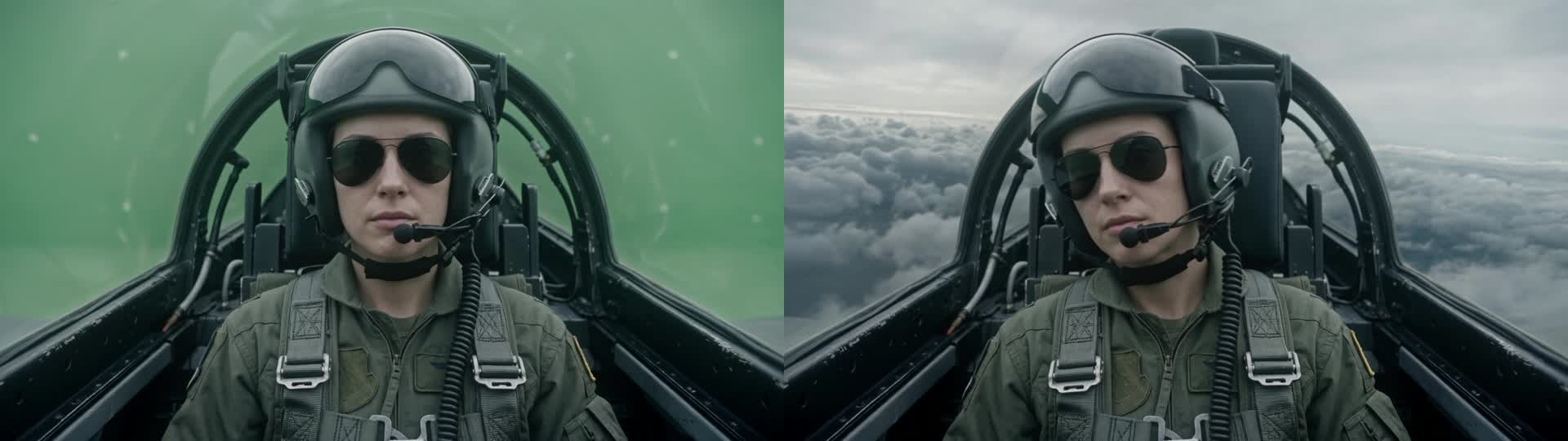
The second season of Amazon’s House of David used AI at scale. Its showrunner, Jon Erwin, describes the method as putting “a very real camera on a very real actor”, with the generated world as “the hand inside a puppet”. The performance, the costume and the eyeline were captured on set, so the shot’s anchor was never the model’s taste.
They build the world first and let the model paint it
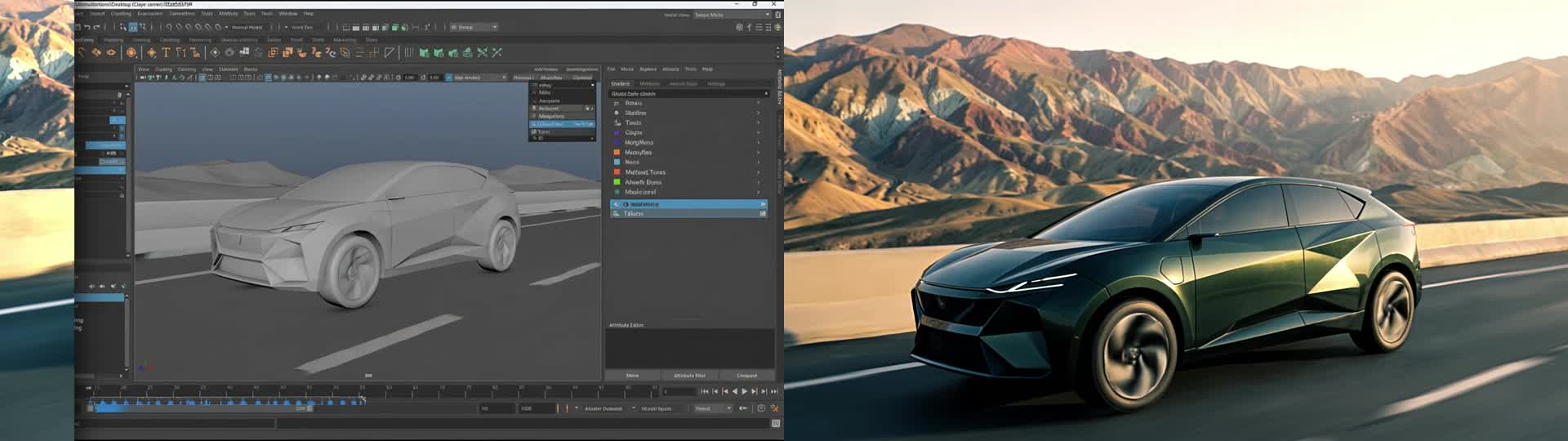
For its environments, the House of David team built the structure of each location in Unreal Engine in about a week, then used AI style transfer to bring it to photoreal and applied the show’s own visual aesthetic and shooting style to the result. The geometry held the world together, and the show’s look decided the surface. The team generated about twenty versions for every shot that made it to screen, and the editorial team reviewed them the way it would review dailies.
They give the model references to follow
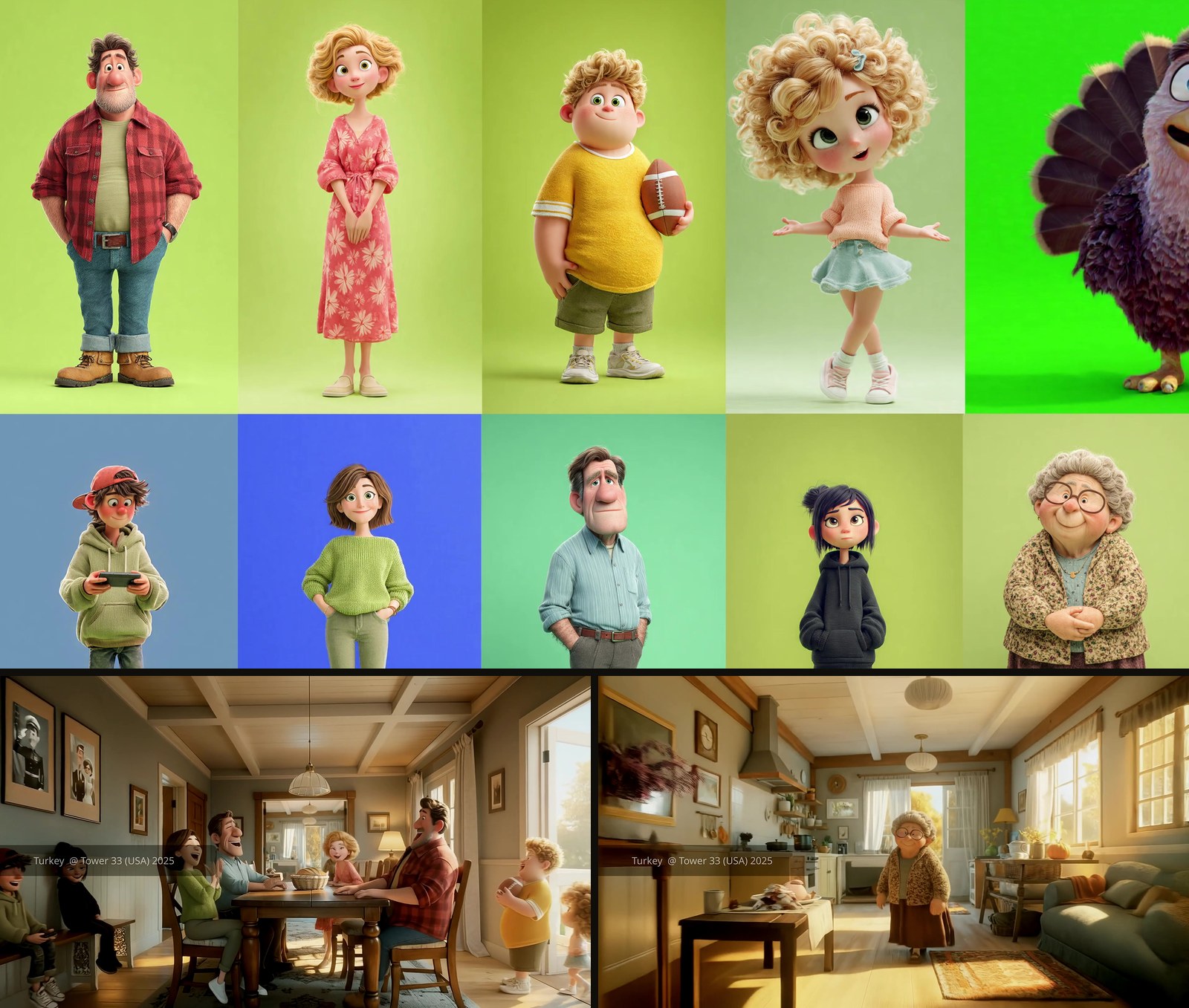
The same applies when there is no actor on set. A character sheet, a set of reference stills and a fixed 3D layout give the model something to match. A shot built that way can be checked against the references frame by frame, and it can be corrected when it drifts.
They finish the shots like film
The finish is where generated material starts to read as film. Air Head, the short that shy kids made for the launch of OpenAI’s Sora in 2024, was presented as a Sora film. Its post-production lead, Patrick Cederberg, later told fxguide that the team generated roughly 300 clips for every one they used, painted out faces the model kept adding to the balloon, and added grain and flicker in the grade to make the material hold together. Ancestra ended the same way: the generated newborn was composited into live-action footage and finished with conventional VFX and colour grading.
“Control is still the thing that is the most desirable and also the most elusive,” Cederberg said.
The AI look is what you get when nobody decided on a look.
Before you commission an AI shot
Ask what the shot starts from
Ask whether the shot starts from a plate, a performance or a 3D layout, or from a sentence. The more of the shot that comes from your production, the less of it comes from the model’s default.
Ask what the model has seen of your show
Ask whether the vendor works from your references, your stills and your graded frames, and whether a model is trained on them. Training on your material raises rights questions as well, which we covered in Using AI in Film and TV: Legal Aspects to Consider.
Ask who owns the grade
Generated shots need the same grade as the rest of the episode, by the same colourist, against the same show LUT. If the AI shots are graded separately, they will look separate.
Ask to see raw and final side by side
Ask any vendor to show you a shot as it came out of the model next to the delivered version. The gap between the two is the work you are paying for. If the vendor cannot show that gap, the delivered shot is probably the model’s default.
If you want a second pair of eyes on the shots you are considering and on the look they have to match, that is the conversation we have with producers before anything is generated.
30 minutes. We’ll figure out if it makes sense for your project. Free, no commitment.
It depends on you
1776 and Ancestra came from the same studio with the same partner. For Ancestra, the production has documented where the look came from: a family’s photographs. House of David started from actors on a set and a world built in 3D. Air Head was finished in the grade like any other film.
So, will your AI shots look like every other AI clip? Only if the look is left to the model. Decided at prep and protected in the grade, it stays yours, which is the same work a camera department has always done.
AI and new media for film and TV professionals. One piece every two weeks. No noise.