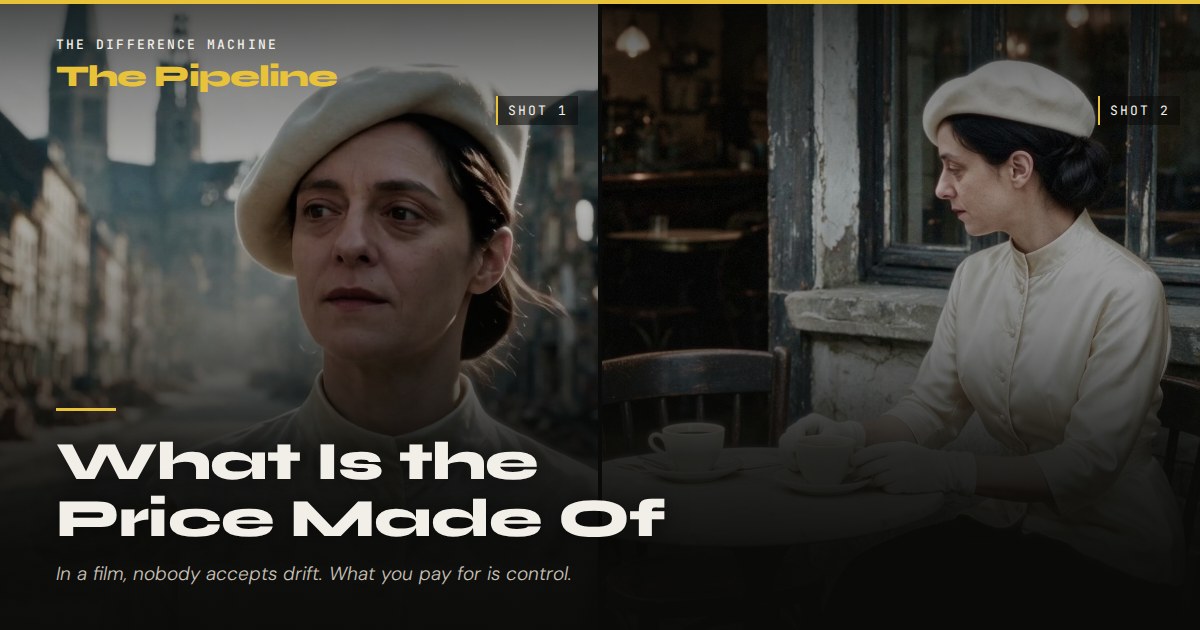
Is there a price per minute for AI shots? Producers ask us this on almost every call. There isn't one, because the price of an AI shot is made of three parts, and only one of them grows shot by shot. The first part is assets: characters and objects built once and reused. The second is scenes: locations rebuilt in 3D, so that every shot in them matches. The third is the shots themselves, priced one by one on top of the first two. Below we go through each part and finish with four questions that sort your own script by them.
Why a minute is the wrong unit
In episode 6 of Netflix's El Eternauta (2025), a building in Buenos Aires collapses. On screen it lasts barely two seconds, inside a flashback montage. The sequence was finished "10x faster than it could have been completed with … traditional VFX tools and workflows", co-CEO Ted Sarandos said, and "the cost of it just wouldn't have been feasible for a show on that budget" any other way.
That collapse is one event, seen once, and nothing in it has to match a shot from another day. For a shot like that the shot itself is nearly the whole price. It's also where generation is at its strongest.
Most films also have shots that have to agree with each other. A video model draws its world again every time it generates. Inside one clip it holds together well, and this year's models take reference sheets and can even generate several connected angles in one pass. Across separately generated shots, made over weeks of notes, a space seen from several angles, a face through a head turn or a set that returns in another episode still drift.
Google DeepMind's own team dealt with this on Ancestra (2025), the short Eliza McNitt directed with Darren Aronofsky's Primordial Soup, made with Veo and live action by a team of more than 200 people. To keep the AI-generated baby the same from scene to scene, they fine-tuned an image model on reference images: "By fine-tuning an Imagen model, we maintained specific and consistent art direction between different scenes." To get one exact camera move, they built a virtual 3D model of a human body, recorded a draft shot by moving a virtual camera through it, and had Veo generate new video along that motion. The people who make the model built a system around it.
We saw the same on a photoreal film we are making for a client this autumn. The first frames we generated looked good one by one. Laid over the client's sketches, they had drifted: the horizon sat in a different place, the furniture had changed shape, and objects that weren't in the sketch had appeared. The composition held only once the space was built as a rough 3D model first, and even then one character's face kept changing through a head turn.
In fast, cheap content some drift gets through. In a film nobody accepts a face that changes between cuts, so control has to be paid for. The three parts below are what that control is made of.
In a film, nobody accepts drift. What you pay for is control.
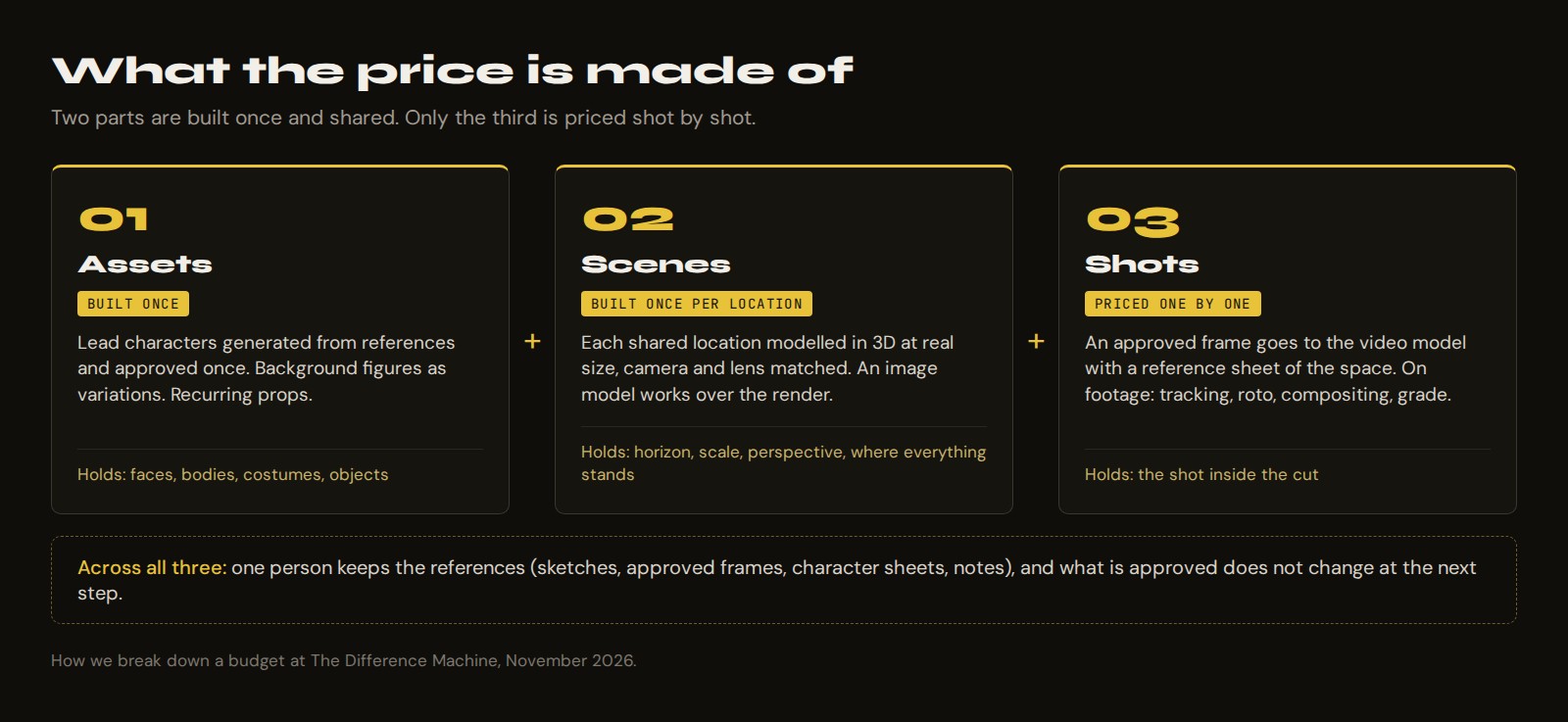
Part one: assets, built once
Assets are everything that has to look the same every time it appears. Lead characters are generated from references, approved once and then reused across the film. Background figures are made as variations of the leads instead of from scratch, which is much cheaper and keeps the ensemble consistent. Props and objects that recur are handled the same way.
Somebody has to keep all of it together. With dozens of shots there are hundreds of references: sketches, approved frames, character sheets, notes. On our budgets this is its own line, an asset manager, because without one the drift comes back. Approval works in steps, and what has been approved does not change at the next step.
None of this will surprise a head of production (Herstellungsleitung). VFX has always been bid from a breakdown: an estimate that, in the words of supervisor Mark Russell, comes down to "the type and quantity of shots, assets and extra materials". A creature is built once, and every shot it appears in is priced on top. On Dune: Part Two, the Fremen eyes were done with a model trained on the hand-finished shots of Part One, then used across more than a thousand shots: built once, paid back by repetition.
Part two: scenes, built once per location
A scene here means a location that several shots share. The whole location is modelled in 3D at real size, with the camera position, angle and lens matched to the reference. A chair can be moved, and when the camera moves, everything in the frame shifts in true perspective. An image model then works over the rendered frame and adds what 3D does slowly: surface, light, atmosphere, fire. The 3D holds where things are, and the model makes them look real.
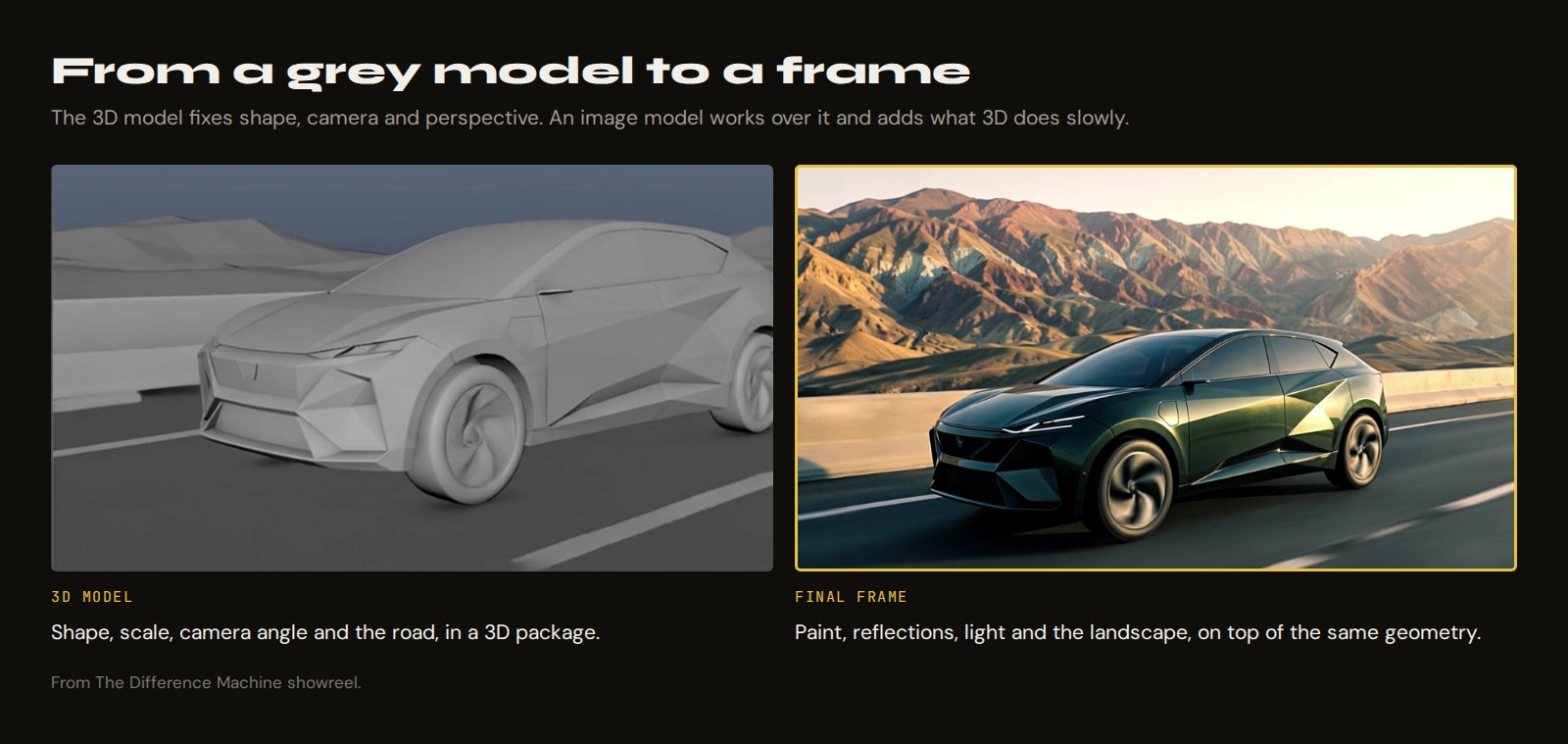
A location build is a fixed cost. It costs the same whether one shot uses it or forty. Spread over one shot, it makes AI look expensive. Spread over forty, it nearly disappears.
Our rule follows from that: build where shots come back, generate where they don't. On the client film, skies and landscape establishing shots are generated. The main locations, where characters are staged across several shots, are built. Big productions work the same way. On the first season of Fallout, the Ghoul's missing nose ran through more than 500 shots, and the vendor tested machine learning and went back to 3D, because the model wouldn't hold across so many body positions, environments and lighting setups. We looked at both Dune and Fallout in more detail in The 47 Small Fixes.
Part three: shots, priced one by one
Now the shot itself. Each one starts from an approved frame, with the scene and the assets in place. That frame goes to the video model together with a reference sheet of the whole space, so the model has the surroundings in front of it instead of inventing them.
When generated elements go into real footage, the classic chain still applies: tracking, rotoscoping (cutting the actor out frame by frame where there is no green screen), compositing into the plate and grading. The generated parts are worked over by hand and composited in, as in any VFX shot.
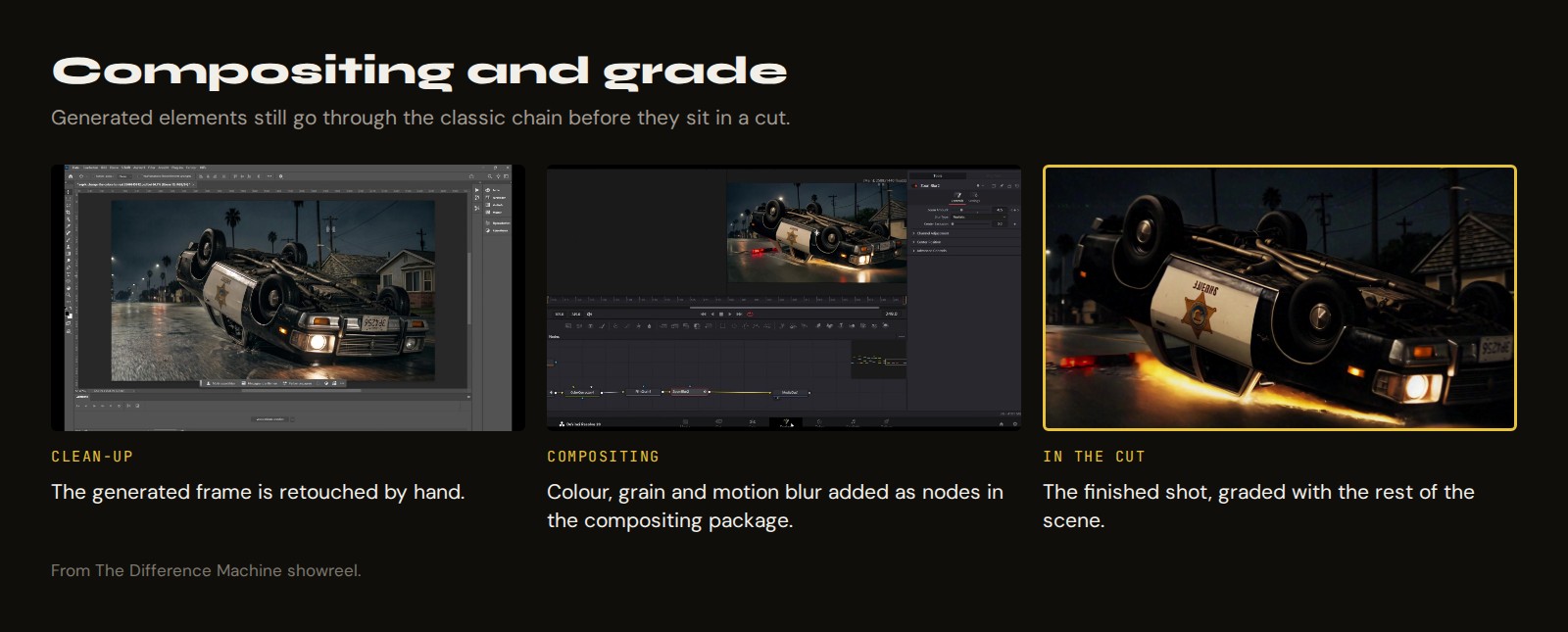
A one-off shot, like the collapse in El Eternauta, skips parts one and two and is priced as a shot alone. On the client film, the fees for the generation itself, the part people expect to be the cost, came out as a small share of a finished shot. That is our own figure, not a market rate.
If you are trying to work out which of your scenes need which parts, that is the conversation we have before anything is generated.
30 minutes. Send your breakdown without numbers, and we write the line next to every shot. Free, no commitment.
Reading your script for it
You can do most of this before you talk to anyone. For each scene with an AI or VFX need, answer four questions.
Who is in the shot?
A landscape with no people in it is the cheapest thing to hold. Faces are the most expensive, especially when they move: a head turn is where identity drifts. Every face the audience reads is an asset.
How many shots share the space, and from how many angles?
One establishing shot is a generation job. Six shots in the same courtyard, from three sides, is a scene to build.
Does it come back?
A location that returns in episode six, or a character who returns next season, turns a one-off into an asset. Price it as one.
Does anything touch an actor in shot footage?
Fire against an arm, smoke around a body, without green screen: that is rotoscoping and compositing, priced per shot like any VFX work.
The answers give you a breakdown with three columns: assets, scenes and shots. At The Difference Machine this is how we price. Send us that breakdown without numbers and we will write the line next to every shot, and tell you which locations are worth building.
AI and new media for film and TV professionals. One piece every two weeks. No noise.
A price per asset, per scene, per shot
When a producer asks us for a price per minute, the honest answer is three short lists: what the assets cost to build, what each location costs, and what each shot costs on top. A single shot of a collapsing building can now fit a budget that couldn't have afforded it before. But a film is many shots that have to agree with each other, and most of the price goes into making them agree.