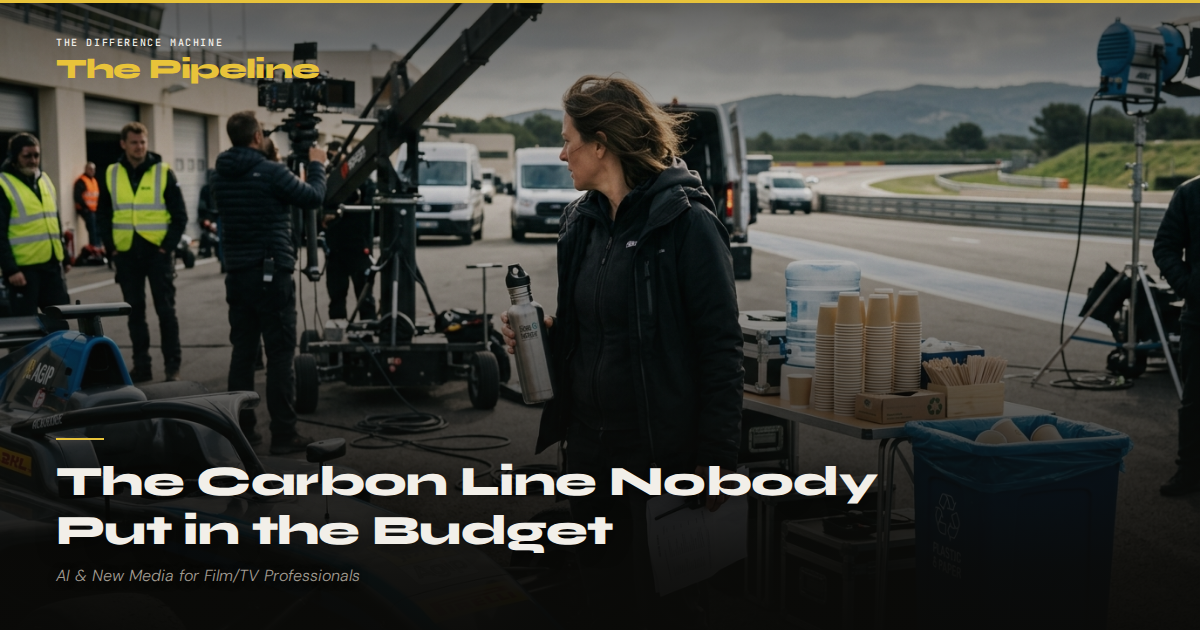
A Herstellungsleiter on a publicly-funded German drama sits down to file the production's climate balance. The catering was regional. The lighting rig was the efficient one. The crew took the train. Every line the industry has trained itself to watch for the past decade is in order. Even with real effort to reduce the impact, a footprint still remains: the generators, getting people to the location, the lights once everyone has arrived. The measures worked exactly as designed. They were never aimed at the part of the footprint that is actually large.
This is where AI production changes the picture, and it is what this article is actually about. Virtual production and AI-assisted background replacement do not make a location trip more efficient, the way a train ticket instead of a flight does. They remove the need for the trip itself: a scene that used to require flying and driving a crew to a real place can instead be shot on a stage, with the environment generated or extended by AI. That is a structurally different kind of reduction than anything currently on the industry's sustainability checklist, and the rest of this piece is about where that reduction is real, where it is not, and what it means for the next Klimabilanz.
When people raise AI's environmental cost, they usually mean the compute behind it: the data centers and processors running the model, which draw real electricity and, for cooling, real water. That is a fair concern for many AI applications. In film production the comparison is different: generating a scene has to be measured against the environmental cost of filming it physically, not against doing nothing at all.
Where the footprint actually comes from
Since the amended Filmförderungsgesetz, German producers on publicly-funded work have to show effective sustainability measures and produce a climate balance for the production. That single obligation turned a topic that used to live in a CSR paragraph into a line item a Herstellungsleiter now personally signs.
The industry-wide data on where that number sits comes from the UK, the only public dataset at this depth, but there is no reason to expect the shape to be structurally different here. BAFTA albert's Accelerate 2025 report measured roughly 175,000 tonnes of CO2e across more than 2,500 productions in 2024. Travel accounted for around 65 percent of it, air travel alone close to a third. On-site energy took another 21 percent, and productions burned three million litres of generator diesel that year. Between them, travel and energy are not a slice of a production's footprint. They are almost all of it.
Germany's own toolkit already knows this. Michael Becker, the Nachhaltigkeitsbeauftragter at SWR, names the same two levers directly: "The biggest levers are usually energy consumption and travel." (In the original German: "Die größten Hebel sind meist der Energieverbrauch und die Reisetätigkeit.") The industry has correctly identified the problem. What it has built to answer it is a different kind of solution.
What Green Shooting does, and does not, reduce
Green Shooting, running in Germany since 2012 and now coordinated nationally with ARD, ZDF and the funders through the Grüner Drehpass, targets exactly the right levers: rail instead of flights, energy-efficient lighting, reusable dishware and water bottles, recycled paper. It is real, it is measured, and it works. SWR's own Tatort: Fünf Minuten Himmel pilot cut 53.6 tonnes of CO2 this way.
Green Shooting makes the trip greener, not optional
What Green Shooting was built to do is optimize a shoot that happens. It was never built to ask whether the shoot has to happen at that location at all. Becker names the limit too: "We hit our limits when the financial means to implement this are not available or budgeted for." The toolkit runs into budget, and it runs into the trip itself. A production can put a crew on a train instead of a plane. It cannot put a crew on a train instead of sending them at all, not with this toolkit.
That is the gap between a Klimabilanz that shows discipline and a Klimabilanz that shows a structurally smaller number. A better toolkit for the trip does not close it. Not taking the trip does. If that gap is on your next schedule, the conversation below is where we look at which specific days it applies to.
How virtual production removes the trip instead of greening it
Virtual production and AI-assisted background replacement sit in a different category from anything on the Green Shooting list, because they do not make the location trip more efficient. They remove it. Two shipped productions make this concrete without any need to invent a case.
DARK BAY: a shoot in Babelsberg instead of five countries
Netflix's 1899 needed an open-sea, multi-national shoot. Philipp Klausing, the show's executive producer, described why that was ruled out before it started: "It was unthinkable to travel across Europe with a crew of 200 people without taking on substantial risk." (In the original German: "Es war undenkbar, mit einem Tross von 200 Mitarbeiter:innen durch Europa zu reisen, ohne ein substanzielles Risiko einzugehen.") The production built the DARK BAY LED volume at Studio Babelsberg instead. Klausing and director Baran bo Odar were talking about logistics and risk, not carbon, and the article draws that second connection itself: a 200-person production that does not travel to five countries has a travel line on its Klimabilanz that a production which does travel there simply does not have. Nobody on 1899 filed that footprint under this heading. It was real regardless.
El Eternauta: a generated collapse instead of a real build
Netflix's El Eternauta needed a building-collapse sequence in Buenos Aires that the production could not afford to stage practically. Co-CEO Ted Sarandos disclosed on the company's July 2025 earnings call that the shot was produced with generative AI because the real build was outside the show's budget. The same principle applies: a destruction sequence that is never physically built, on location, with the trucks and the site power that a practical build needs, does not generate that build's footprint either.
Sony Pictures Television has run the closest thing to a direct comparison: an analysis by the consultancy ICF, published through Sony's Greener World program, comparing on-location against virtual-production emissions on matched scenes from two of its own television productions. The result: total production emissions ran 76 to 80 percent lower for the virtual versions, driven mainly by the travel, generators, and hotel stays the on-location shoots needed and the virtual ones did not. The sample is small, two shows, a handful of scenes each, and ICF's own report says explicitly that the results should not be generalized to every virtual production. It is still a real, primary-sourced comparison rather than an industry rumor, and a separate 2023 life-cycle study for the Sustainable Production Alliance, run by UCLA's Institute of the Environment and Sustainability, found the same direction across three different scenario types.
None of this makes the case that AI production is carbon-neutral, and none of it removes the Klimabilanz-filing requirement. A season is not one volume day. What changes is what goes on the report, not whether a report gets filed.
What this means for your next schedule
The practical question for a Herstellungsleiter is not whether to run Green Shooting. Run it regardless, it is real and it is free savings on the trip that is happening anyway. The separate question is which specific location days on the schedule are the ones actually driving the travel and energy lines, and whether any of them are candidates for a volume day or an AI-generated background instead of a practical build.
That is a scene-by-scene question, not a policy. Not every location can move indoors, and not every sequence should. But on a schedule with an international leg, a hard-to-reach location, or a destruction or period build that was already flagged as expensive, the same conversation that used to be about budget is now also about the number the production has to report at the end.
The measures the industry built to answer this problem were aimed at the trip. The largest number on the report was never the trip getting greener. It was the trip happening at all.
That scene-by-scene question, which days on this specific schedule are the removable ones, is exactly what a consult with us is built to answer. Thirty minutes is usually enough to map it against your own shot list.
The report still gets filed
The Herstellungsleiter from the opening still has to file that Klimabilanz. The catering line, the lighting line, the travel-mode line stay exactly as disciplined as they were. What changes is which location days on the next schedule get asked the harder question before they are locked: not "how do we get there more efficiently," but "does this sequence need the trip at all."
The industry spent a decade building measures for the number that turned out to be the smaller one. The larger number was always the trip itself, and that is now the question to ask before the schedule locks, not after the report is filed.